Managing after-hours pet cremation logistics using phone calls and paper notes leads to catastrophic chain-of-custody errors and delayed response times. When a grieving family waits hours for a technician who got lost because of a transcribed address error, your facility's reputation is permanently destroyed. DispatchNode provides an AI-native dispatch platform that automates after-hours routing, supports GPS tracking, and enforces consistent chain-of-custody documentation documentation from the moment of pickup.
The Logistical Chaos of the Night Shift
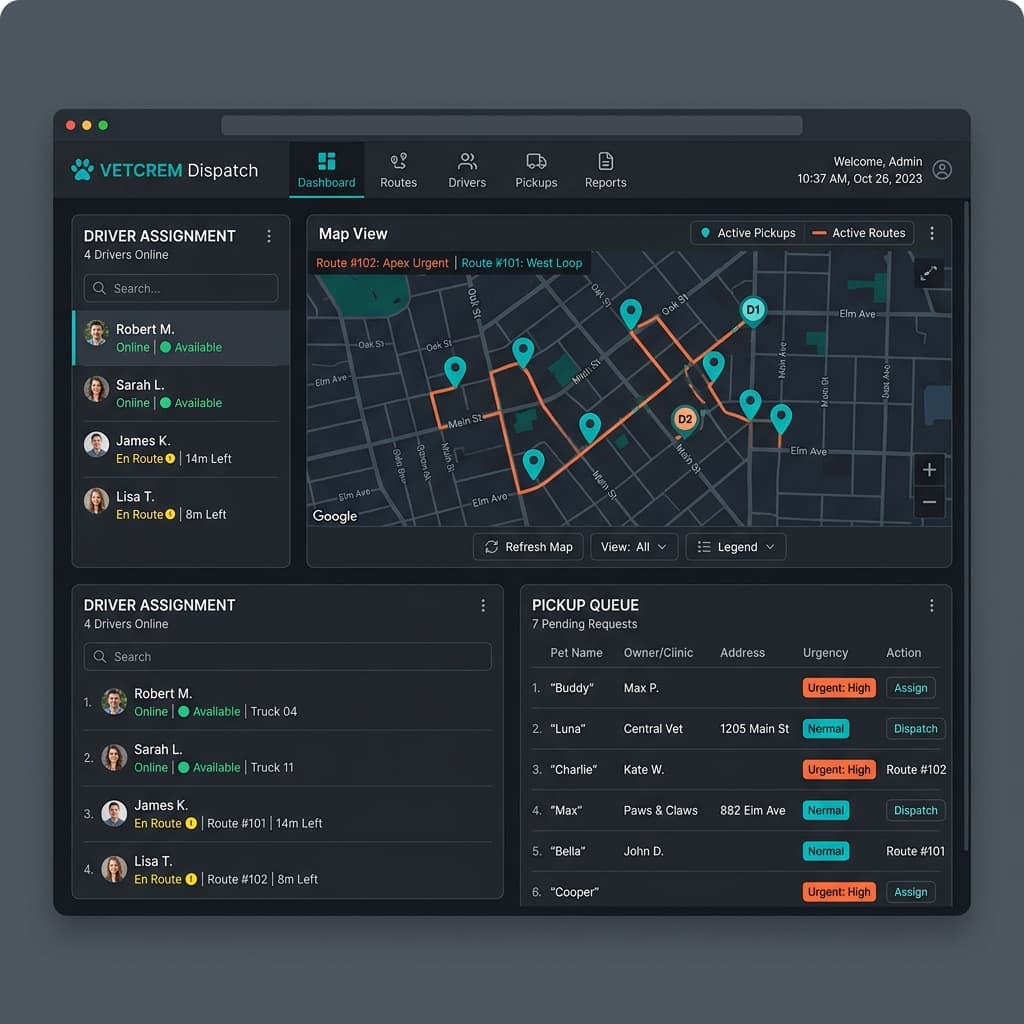
The night shift is inherently disorganized; relying on groggy technicians to manually map addresses and calculate ETA times introduces massive operational friction. DispatchNode replaces manual late-night logistics with an autonomous routing engine that instantly calculates the fastest path to the client's home, overriding the driver's mobile device with turn-by-turn navigation the second the after-hours call is completed.
When an after-hours call is accepted, the speed of the physical response is critical. The family is waiting, highly distressed, with their deceased pet. If the on-call driver spends fifteen minutes typing the address into Google Maps, getting dressed, and trying to find the keys to the transport vehicle, the delay exacerbates the family's trauma. The technology must remove all administrative friction from the driver's workflow.
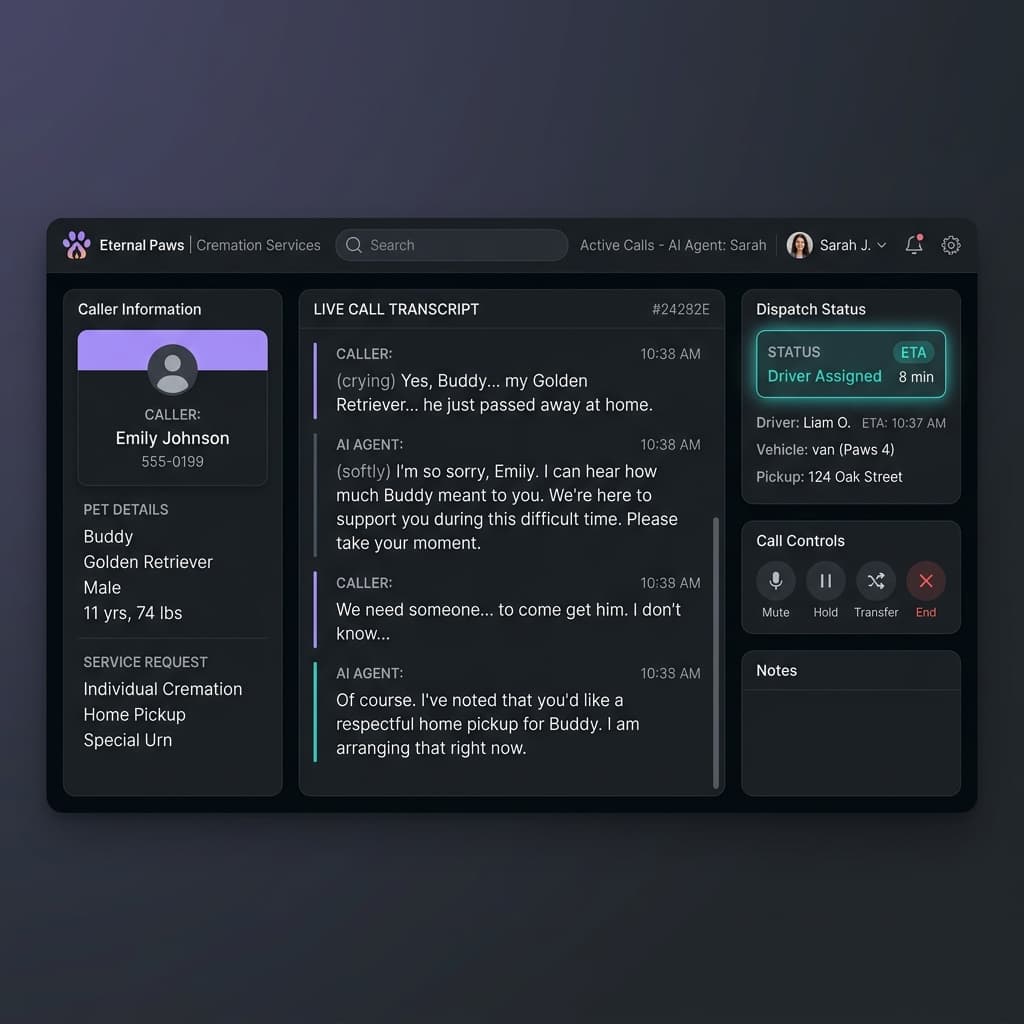
The dispatch platform executes this flawlessly. When the AI voice agent confirms the address with the caller, the system instantly validates the GPS coordinates and pushes the route to the driver's tablet. The driver does not need to enter any data; they simply tap "Acknowledge" and begin driving. This shaves critical minutes off the response time, demonstrating to the family that the facility treats their situation with the utmost urgency.
Furthermore, if the driver is already on the road returning from a different removal, the system dynamically reroutes them. It analyzes the live GPS position of the transport vehicle and smoothly injects the new emergency pickup into the sequence, ensuring that the closest available asset is always utilized, drastically reducing total windshield time and fuel consumption.
Guaranteeing the Chain of Custody
The most terrifying scenario for a pet aftercare facility is losing track of a pet's remains or returning the wrong ashes to a family. DispatchNode enforces an unbreakable digital chain of custody, requiring the driver to scan a unique barcoded tracking tag the absolute moment the pet is transferred to their care, permanently linking the physical remains to the digital contract.
In manual operations, drivers frequently use paper tags with handwritten names. These tags fall off, smear, or become illegible during transport. When the remains arrive at the crematory the next morning, the staff is forced to guess which pet is which, leading to catastrophic misidentifications that result in massive lawsuits and the total destruction of the business's reputation.
The AI platform makes this impossible. The driver arrives at the home equipped with highly durable, serialized barcode tags. Before they leave the premises, the mobile app forces them to affix the tag to the transport bag and scan it using the tablet's camera. This scan locks the GPS coordinates, timestamp, and pet's information into an durable digital ledger.
Every subsequent time the pet is moved—from the truck to the cold storage facility, from storage to the cremation retort, and from the retort to the final urn—the barcode must be scanned. This perfect traceability provides absolute peace of mind to the business owner and allows them to legally prove the identity of the remains if a family ever questions the integrity of the process.
Transparent Communication with the Family
Leaving a grieving family in the dark while they wait for a driver creates immense anxiety and frustration. DispatchNode provides automated, highly respectful SMS updates to the family, providing live GPS tracking of the approaching vehicle so they know exactly when the technician will arrive, allowing them to prepare themselves emotionally for the removal.
The period between the phone call and the arrival of the technician is excruciating for the pet owner. Every passing minute feels like an hour. If the driver hits unexpected late-night construction traffic and is delayed, the family assumes they have been forgotten. This communication void breeds resentment.
The system fills this void with transparency. The moment the driver begins the route, the family receives a text message: "Our technician, Sarah, is en route. You can view her approximate arrival time here." The included link opens a discreet, branded map showing the vehicle's progress. This allows the family to spend their final moments with their pet in peace, rather than anxiously staring out the window.
This level of professional communication mirrors the technology used by high-end logistics companies like Uber or FedEx, but it is applied with the necessary sensitivity of the death care industry. It drastically elevates the perceived professionalism of the aftercare facility, guaranteeing positive online reviews and strong community recommendations.
Integrating with Crematory Operations
A successful after-hours removal must smoothly integrate into the morning crematory workflow; arriving at an office with unlogged remains creates massive administrative bottlenecks. DispatchNode automatically transfers all data collected during the night shift directly into the primary facility management dashboard, ensuring the morning staff knows exactly what inventory arrived overnight and what services need to be scheduled.
When the morning manager arrives at the facility, they do not want to hunt down the night-shift driver to decode handwritten notes. They need immediate visibility into the current operational load. The software provides a clean, digital dashboard displaying every pet that was removed during the night, their exact location in the cold storage facility, and the specific cremation services requested by the family.
If the family requested specialized urns, paw print impressions, or fur clippings during the initial late-night phone call, these requests are clearly highlighted in the daily manifest. The staff can immediately begin processing the orders without having to call the family back to confirm the details, protecting the family from having to repeat traumatic conversations.
By creating a reliable digital bridge between chaotic after-hours field execution and highly structured daytime facility operations, the platform ensures that the business runs with perfect efficiency. Errors are eliminated, families are cared for perfectly, and the facility scales its revenue without collapsing under administrative friction.
Evaluating Crematory Software Platforms
When upgrading your facility to handle 24/7 autonomous logistics, selecting the correct software vendor is paramount. Legacy software built in the 2010s relies on manual data entry and static forms, whereas modern platforms are AI-native and utilize real-time geolocation.
| Feature | Legacy Cremation Software | DispatchNode AI Platform | Business Impact |
|---|---|---|---|
| Call Answering | Manual / Voicemail | Autonomous AI Voice Agent | Zero missed calls after 5:00 PM |
| Routing Algorithm | Static Zip Codes | Dynamic GPS Traffic Routing | 30% reduction in fuel & windshield time |
| Chain of Custody | Paper Tags / Manual Logs | Digital Barcode Scanning | Eliminates liability and lost remains |
| B2B Veterinary Portal | Phone Calls Only | 1-Click Digital Dispatch | Secures exclusive clinic contracts |
| Payment Capture | Next-day Invoicing | Automated SMS Stripe Links | Secures deposits before truck rolls |
As evident in the data above, relying on legacy solutions severely limits a facility's ability to scale. Modernizing the tech stack is non-negotiable for facilities looking to dominate their local market. For a deeper analysis on operational scaling, review our guide on AI Dispatch for Pet Crematories.
The Technical Architecture of Dispatch
To truly understand how this technology prevents operational chaos during the night shift, we must look at the underlying data architecture. The system relies on a unified, bi-directional flow of information between the grieving family, the central database, and the driver's mobile device.
This structural flow ensures that data is only collected once (by the AI) and automatically flows downstream to the driver and the morning crematory staff, entirely eliminating transcription errors.
Steps to Onboard Digital Dispatch
Transitioning from pen-and-paper to an AI-driven dispatch environment requires a focused onboarding strategy. Operators should follow this structured deployment path:
- Hardware Standardization: Equip all transport vehicles with ruggedized tablets capable of high-resolution barcode scanning and continuous GPS broadcasting.
- Zone Mapping: Define specific geographic service territories and establish base pricing and mileage surcharges for each zone.
- Veterinary Clinic Integration: Deploy the B2B portal to your top 5 highest-volume partner clinics, providing them with immediate access to 1-click digital dispatching.
- Staff Training: Ensure all morning staff understand how to interpret the digital manifest generated by the night-shift drivers.
- Compliance Verification: Audit the digital chain-of-custody logs to ensure they meet the rigorous tracking requirements set forth by organizations like the EPA (Environmental Protection Agency) regarding biohazardous transport and cremation emissions.
By standardizing these protocols, the facility guarantees a reliable transition into modern, automated logistics.
Asynchronous Coordination with Veterinary Partners
The operational relationship between a pet crematory and its veterinary clinic partners is the bedrock of the enterprise's revenue stream. Clinics generate consistent, high-volume communal and private cremation contracts. However, the logistical coordination between the crematory dispatch center and the clinic's veterinary technicians is frequently fraught with friction, particularly regarding after-hours scheduling and capacity management.
Veterinary clinics are high-stress environments. When a vet tech needs to schedule a pickup for three deceased pets, they do not have ten minutes to wait on hold while a crematory dispatcher attempts to locate an available driver. They need an asynchronous, zero-friction method of communication that integrates directly into their existing workflow.
Advanced dispatch software facilitates this through dedicated B2B (Business-to-Business) clinic portals and API integrations. Instead of calling, the vet tech simply logs into a secure tablet interface provided by the crematory. They input the weight of the pets, the required cremation types, and any specific memorialization requests (such as clay paw prints).
The software processes this request asynchronously. It instantly calculates the total volumetric weight, queries the live GPS locations and available capacity of the active removal vehicles, and automatically adds the clinic to the optimized route manifest of the nearest truck. The system then sends a silent push notification back to the clinic's tablet: "Pickup confirmed. Driver ETA is 45 minutes." This completely eliminates the need for synchronous phone communication, saving invaluable time for both the clinic staff and the crematory dispatcher, and solidifying the crematory's status as the preferred, low-friction vendor for the clinic.
Dynamic Geofencing and Biohazard Security
The transportation of deceased pets is subject to strict local and state environmental health regulations. Operators must maintain strong control over the chain of custody and ensure that removal vehicles do not deviate from authorized routes while transporting biological material. Relying on the honor system or generic GPS tracking dots on a map is insufficient for mitigating this liability.
Modern dispatch platforms deploy advanced dynamic geofencing to enforce absolute spatial security. A geofence is a virtual perimeter drawn over a real-world geographic area. When an operator establishes their service territory within the software, they define strict operational boundaries.
If a driver, perhaps attempting to run a personal errand, drives the removal vehicle outside of the established geofence while carrying deceased pets in the cargo area, the system instantly detects the perimeter breach. The software triggers a high-priority "Deviation Alert" to the operations manager's mobile device.
Furthermore, the software can utilize micro-geofencing around specific authorized disposal and processing facilities. If a driver claims to have transferred a communal load to the primary retort facility, but the telematics data proves the truck never actually entered the micro-geofence of the facility's loading dock, the software flags the discrepancy as a severe security violation. This absolute spatial telemetry ensures that the operator maintains an unbreakable, mathematically verifiable chain of custody, protecting the business from catastrophic health department fines and devastating public relations crises.
The integration of dynamic geofencing also extends to the management of specialized sub-contractors. In highly dispersed rural areas, operators frequently utilize third-party transport services to handle extreme-distance removals. The dispatch software generates temporary, secure mobile portals for these sub-contractors, enforcing the exact same geofenced chain-of-custody protocols as the internal fleet. This ensures that even when utilizing external logistics partners, the primary operator maintains absolute, verified control over the biological material, helping reduce exposure to third-party negligence.