A grieving family whose pet passes away at 2:00 AM does not want to leave a voicemail and wait for a callback the next morning. If your aftercare facility is closed or relies on an answering machine, you instantly lose the client to a competitor who answers the phone. DispatchNode deploys compassionate AI voice agents to provide 24/7 availability, answering every call with empathy and instantly dispatching removal teams while your human staff sleeps.
The Emotional Weight of After-Hours Calls
Pet loss does not adhere to standard business hours; a significant percentage of natural passing occurs late at night. DispatchNode provides an AI voice agent specifically trained in grief counseling protocols, ensuring that every midnight caller is greeted with profound empathy and absolute professionalism, establishing immediate trust during the most difficult moment of the pet owner's life.
When an elderly dog passes away in the middle of the night, the family is often entirely unprepared. They are emotional, confused, and desperately seeking guidance on what to do next. If they call a crematory and hear a sterile answering machine instructing them to "call back during business hours," it feels like a massive emotional abandonment. They will immediately hang up and search for a facility that offers immediate assistance.
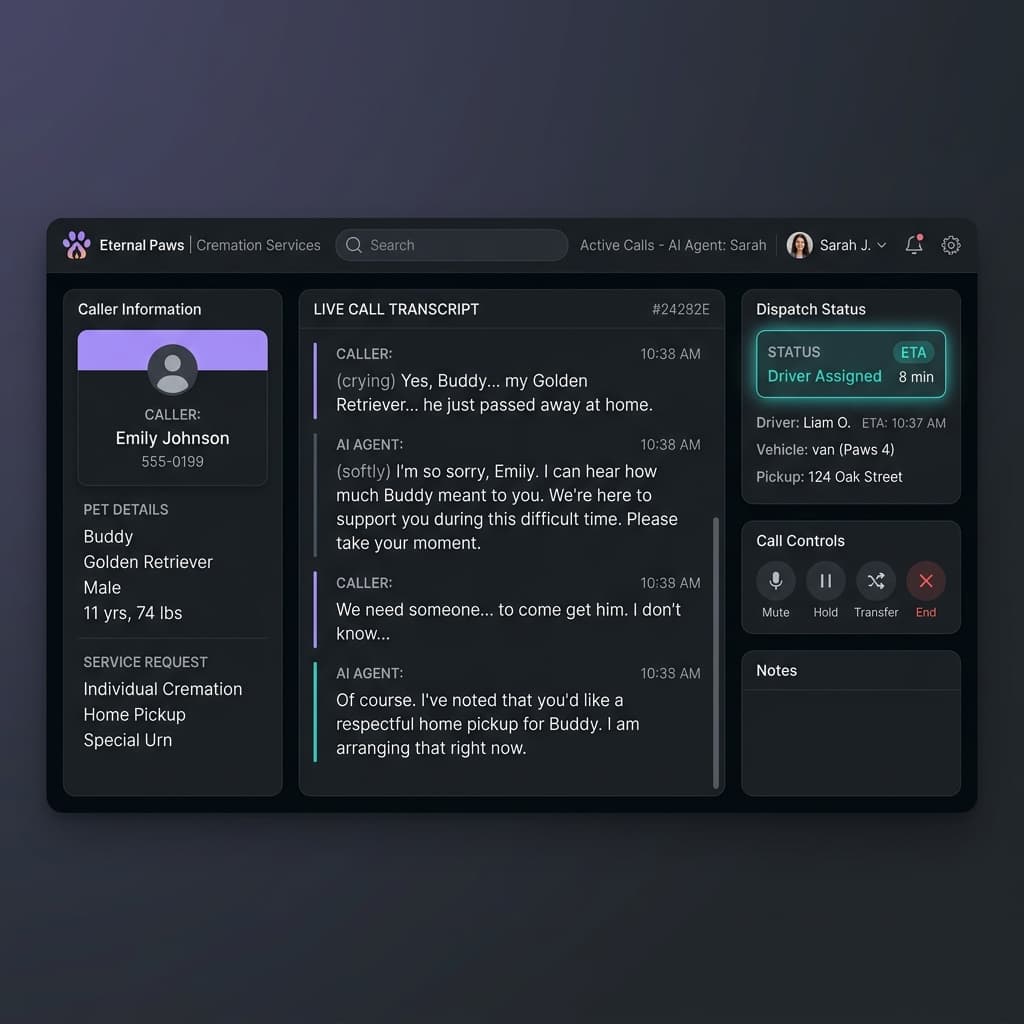
The AI agent changes this dynamic entirely. It is programmed to speak with a calm, highly empathetic tone. It acknowledges the loss immediately: "I am so incredibly sorry for your loss. I know this is a difficult time. We are here to help you." This initial validation is the most important part of the interaction. Once the emotional connection is established, the AI gently guides the caller through the necessary logistical steps.
By providing this high level of emotional support at 2:00 AM, the aftercare facility transitions from a simple service provider to a trusted partner in the grieving process. The family feels supported and cared for, ensuring they will entrust their beloved pet's remains to the facility.
Automating the After-Hours Dispatch
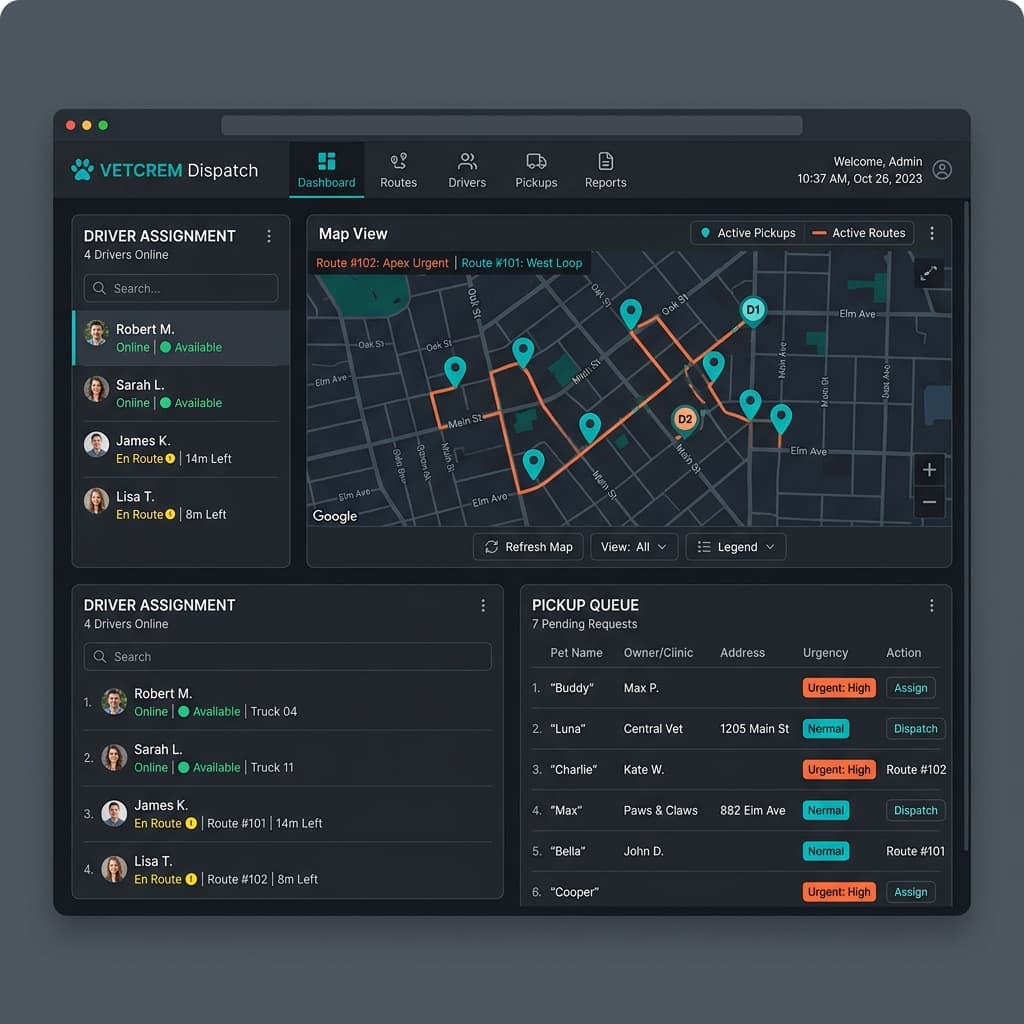
Providing a compassionate voice on the phone is only the first step; the facility must be able to execute the physical removal immediately. DispatchNode integrates the AI voice agent directly with a dynamic routing algorithm, allowing the system to instantly locate the on-call removal technician via GPS and dispatch them to the family's home without any manual intervention from a dispatcher.
Many facilities attempt to handle after-hours calls by forwarding the main office line to the on-call driver's personal cell phone. This is a terrible strategy. A driver awakened from a deep sleep is rarely capable of projecting the necessary empathy, and trying to write down an address while groggy leads to massive routing errors. Furthermore, this approach burns out the technicians rapidly.
The AI platform automates the entire sequence. After consoling the family, the AI asks for the home address and the approximate weight of the pet. It then cross-references this data with the active on-call schedule. The system pushes a high-priority, silent-override notification to the designated driver's mobile device, waking them up with a fully formatted work order containing turn-by-turn navigation and the specific details of the call.
This smooth automation ensures that the driver can focus entirely on executing a professional, respectful removal rather than fumbling with logistics. The family receives an automated SMS update: "Our technician, John, is on his way and will arrive in approximately thirty-five minutes." This transparency provides massive relief to the grieving family.
The Financial Impact of Missed Calls
Every missed after-hours call represents a direct loss of high-margin revenue and a permanent loss of a potential lifelong client. DispatchNode helps operators document and enforce that zero calls are missed by providing an infinitely scalable AI infrastructure that handles multiple concurrent emergency calls simultaneously, capturing every available revenue opportunity in your market regardless of the hour.
The pet aftercare industry is highly competitive, and the average revenue per client (accounting for private cremation, specialized urns, and memorial products) is substantial. Losing a single client at 3:00 AM because the phone rolled to voicemail is a devastating financial hit. Over the course of a year, these missed after-hours calls can easily add up to hundreds of thousands of dollars in lost top-line revenue.
Traditional human answering services are an expensive and inadequate solution. They charge exorbitant per-minute fees and frequently place callers on hold if volume spikes. Placing a grieving pet owner on hold is catastrophic; they will hang up. The AI agent never places a caller on hold. If three different families call simultaneously at midnight, the system spins up three independent AI agents to handle the calls with identical empathy and precision.
By securing every single inbound lead, 24/7, the facility achieves total market dominance. They establish a reputation in the community and among local veterinary clinics as the single most reliable aftercare provider, driving massive organic referrals and aggressive financial growth.
Coordinating with Emergency Veterinary Clinics
A massive percentage of after-hours pet passing occurs at 24/7 emergency veterinary clinics, and these clinics demand immediate removal services to free up critical triage space. DispatchNode provides emergency clinics with a dedicated digital portal to request instant removals, bypassing the phone system entirely and automatically routing your closest available driver to the clinic.
Emergency veterinarians operate in highly chaotic, high-stress environments. When a pet passes away on the table, the clinic needs to move the remains respectfully but quickly to make room for the next emergency case. If they have to wait on hold for a crematory dispatcher, they will simply call a competitor who is faster.
The software provides the clinic with a "one-click" dispatch button on their tablet. When the button is pressed, the system automatically generates a removal work order containing the clinic's address and the specific details of the pet. The routing engine instantly alerts the on-call driver, completely bypassing the need for a phone conversation.
This extreme efficiency makes the pumping operator indispensable to the veterinary clinic. By streamlining the removal process and freeing the veterinary staff from administrative delays, the aftercare facility guarantees that they will remain the exclusive vendor for that clinic's highly lucrative after-hours cremation volume.
Comparing After-Hours Solutions
For modern pet aftercare businesses, choosing the right nighttime communication strategy is the most critical operational decision you will make. To understand the operational and financial impact, we must compare the three dominant approaches used in the industry today.
| Solution | Empathy Level | Hold Times | Dispatch Capability | Monthly Cost | Scalability |
|---|---|---|---|---|---|
| Voicemail | Zero | N/A (Missed Call) | None | Free | Infinite (but useless) |
| Human Answering Service | Low (Scripted) | High (Often 5+ minutes) | Basic Message Taking | $300 - $800+ | Limited by human agents |
| DispatchNode AI Agent | High (Grief-Trained) | Zero | Instant GPS Routing | Flat-Rate SaaS | Infinite (Concurrent Calls) |
As the data clearly demonstrates, relying on traditional human answering services introduces massive friction into the after-hours pet loss communication pipeline. Human operators in generic call centers cannot adequately project the emotional warmth required, and placing a grieving caller on hold is an immediate dealbreaker.
Implementing a 24/7 AI Workflow
Deploying a compassionate, always-on AI dispatch system is not a complicated technical hurdle. By following a structured implementation plan, any pet crematory or removal service can modernize their after-hours operations within a matter of days.
- Audit Current Call Volume: Analyze your telephony data to determine exactly how many calls your facility receives between 8:00 PM and 6:00 AM.
- Define the Dispatch Radius: Map out your after-hours service zones and assign specific on-call technicians to geographic territories.
- Train the AI Persona: Customize the AI agent's voice, pacing, and specific intake questions to match the unique brand voice of your facility.
- Integrate Payment Processing: Connect the AI to Stripe so that sensitive deposit collection happens automatically via SMS without requiring the family to read a credit card number aloud.
- Establish Veterinary Protocols: Educate your partner clinics on the new automated dispatch portal to streamline B2B after-hours requests.
Following these steps ensures that your facility operates in total compliance with industry best practices, such as those recommended by the AVMA (American Veterinary Medical Association) regarding compassionate end-of-life care and communication.
The After-Hours Dispatch Sequence
To visualize exactly how the DispatchNode platform orchestrates a midnight emergency removal without human intervention, review the technical sequence diagram below:
This automated, frictionless pipeline guarantees that the family is supported immediately while the operational logistics are executed with absolute precision in the background.
The Economics of After-Hours Empathy
The financial architecture of the pet aftercare industry is disproportionately weighted toward the after-hours segment. Veterinary clinics operate on predictable schedules, but the biological reality of pet end-of-life care is inherently unpredictable. A massive percentage of residential home euthanasias and unexpected passings occur between 6:00 PM and 2:00 AM. For a crematory operator, capturing this high-intent, highly vulnerable demographic is the key to dominating the local market.
However, providing true 24/7 availability presents a brutal economic paradox for independent operators. Hiring dedicated, highly trained human dispatchers to staff a graveyard shift is financially crippling. A single dedicated night dispatcher requires a salary, benefits, and payroll taxes—often exceeding sixty thousand dollars annually—just to sit in an office waiting for the phone to ring. If the phone only rings twice a night, the cost-per-acquisition for those specific cremation contracts skyrockets, destroying the profit margin.
Many operators attempt to circumvent this cost by utilizing generic answering services or an on-call rotation for their daytime staff. Both solutions fail catastrophically. Answering services lack the nuanced empathy and specialized knowledge required for grief counseling, treating the call like a pizza delivery order. An on-call driver, woken up at 3:00 AM, is often groggy and focused solely on logistics, completely failing to provide the psychological support the grieving family desperately needs.
Advanced AI voice platforms resolve this economic paradox completely. The AI agent provides infinitely scalable, zero-latency availability without the massive fixed costs of a night shift. The AI does not experience fatigue, it does not require a salary, and its emotional cadence—specifically programmed for profound, stabilizing empathy—is perfectly consistent whether the call is answered at 2:00 PM or 2:00 AM. This capability allows the independent operator to capture one hundred percent of the lucrative after-hours market share, maximizing revenue while entirely decoupling dispatch availability from human labor costs.
Cognitive Load Management During Acute Grief
Understanding the psychological state of a client calling an aftercare facility is critical to designing a successful dispatch protocol. When a pet owner calls following the unexpected passing of a beloved companion, they are experiencing extreme acute grief. This psychological state severely degrades their executive function—specifically their working memory and their ability to process complex logistical choices.
If an operator subjects this grieving client to a high cognitive load, the interaction will fail. A traditional IVR (Interactive Voice Response) system that forces the caller to "Press 1 for Private Cremation, Press 2 for Communal Cremation" is emotionally offensive and cognitively overwhelming. The caller is too distraught to weigh the nuanced differences between cremation types; they simply want to know that their pet will be handled with dignity.
A sophisticated AI voice agent utilizes conversational natural language processing to drastically lower the client's cognitive load. The AI does not present a menu of options. It begins by establishing emotional anchoring: "I am so incredibly sorry for your loss. I know this is a terribly difficult time. Let's just take this one step at a time."
The AI then guides the conversation linearly, asking single, simple questions. Instead of asking the client to choose a service tier, the AI asks, "Would you like your pet's ashes returned to you in a memorial urn?" This simple yes/no question allows the AI to determine the appropriate cremation type on the backend without forcing the client to navigate industry terminology. Furthermore, if the client begins to cry or loses their train of thought, the AI patiently waits, never interrupting, and gently returns to the logistical workflow when the client is ready. This mastery of cognitive load management ensures the booking process is a source of comfort rather than an additional source of trauma.