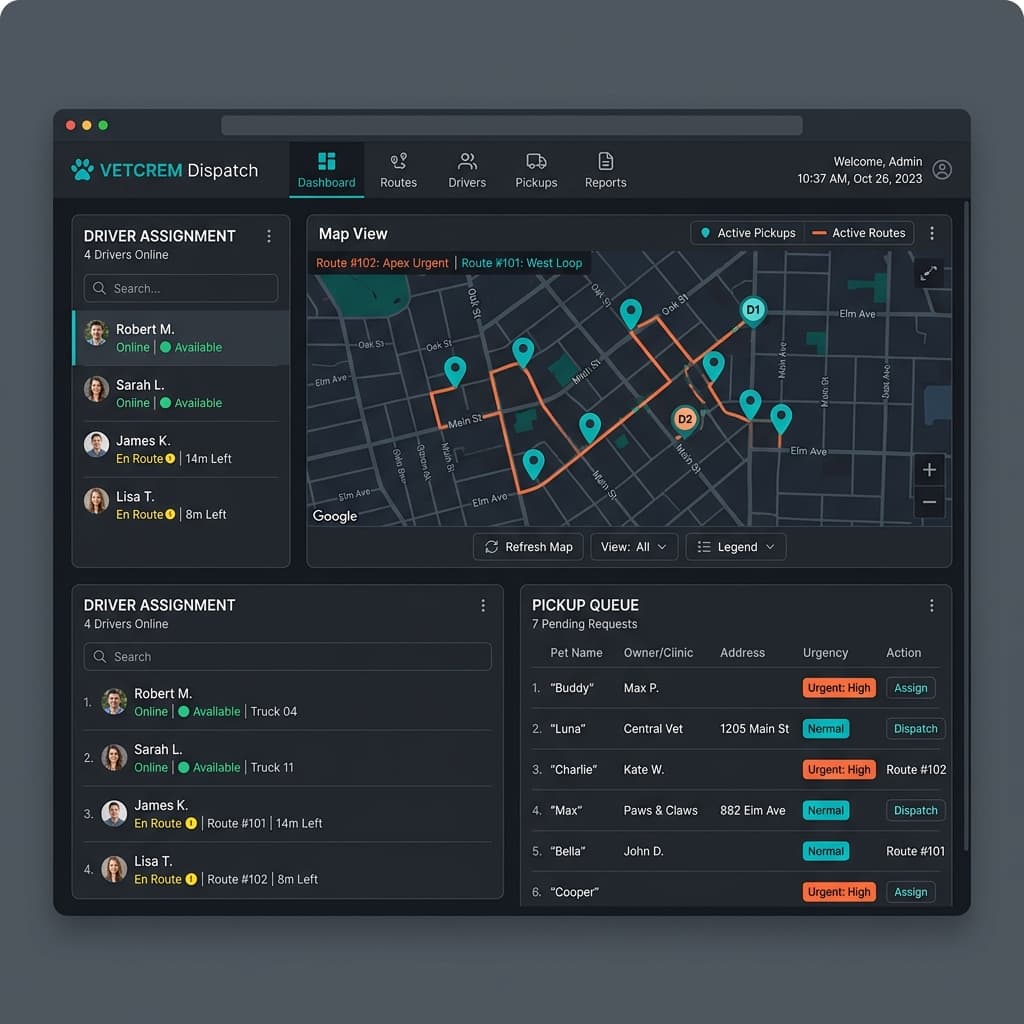
Scaling a pet crematory using manual routing means your drivers will spend more time sitting in traffic than executing respectful removals. As your daily pickup volume grows across dozens of veterinary clinics and scattered residential homes, manual dispatching inevitably collapses, leading to missed pickups and furious clinic managers. DispatchNode deploys an AI routing engine that algorithmically clusters all daily removals into mathematically perfect routes, allowing your crematory to scale infinitely with maximum fleet efficiency.
The Complexity of Crematory Routing
Managing a daily manifest that includes scheduled veterinary sweeps, emergency residential pickups, and massive variation in payload size requires computational power, not a whiteboard. DispatchNode analyzes the geographic distribution of all required daily stops and dynamically generates highly dense service routes that minimize cross-town driving and maximize the volume of removals a single transport vehicle can execute per shift.
A typical crematory operates on two distinct logistical tracks. First, they must perform scheduled "sweeps" of their partner veterinary clinics, picking up multiple pets at once. Second, they must respond to unpredictable, ad-hoc residential removal requests. Attempting to manually weave these unpredictable residential stops into the fixed veterinary schedule is a logistical nightmare that frequently results in drivers arriving late to their most important clinic accounts.
The AI routing engine resolves this tension automatically. It establishes the high-priority veterinary clinics as the anchor points of the daily route. When a residential request comes in, the algorithm calculates the exact geographic deviation required to service the home. It then smoothly injects the residential stop into the driver's route precisely when they are in that specific neighborhood, ensuring maximum efficiency.
This algorithmic discipline prevents the classic failure mode of a driver crossing the city three times in one day. By maintaining strict geographic density, the crematory drastically reduces fuel consumption, extends the lifespan of their transport vehicles, and ensures that drivers are rarely pushed into expensive, fatigue-inducing overtime hours.
Managing Vehicle Capacity and Weight
Transporting deceased pets requires strict adherence to vehicle weight capacities and spatial constraints within the transport cabin. DispatchNode tracks the estimated weight and physical footprint of every scheduled pickup, ensuring that a driver is never dispatched to a veterinary clinic to pick up a large breed dog when their transport vehicle is already physically full.
A driver arriving at a clinic and refusing a pickup because their truck is full is highly embarrassing and damages the crematory's relationship with the veterinary staff. The dispatch platform prevents this by utilizing predictive capacity modeling. When an order is generated, the dispatcher or the veterinary portal inputs the approximate weight of the pet (e.g., Feline, Small Canine, Giant Canine).
The system continuously tallies the cumulative weight assigned to each driver's manifest. If the addition of a new stop pushes the vehicle past its safe operating capacity or its physical storage limits, the algorithm automatically rejects the assignment for that specific truck. It instantly reroutes the job to the next closest vehicle that has verified available capacity.
This intelligent load balancing ensures that every transport vehicle operates at maximum efficiency without ever causing a disruption at the point of service. It also allows management to make data-driven decisions about fleet utilization. If the system constantly flags capacity bottlenecks in a specific zip code, the crematory owner knows precisely where to deploy an additional transport van to alleviate the pressure.
Automating the Veterinary Sweep Schedule
Veterinary clinics demand highly predictable, reliable pickup schedules; if they do not know exactly when the crematory driver will arrive, their cold storage facilities become overwhelmed. DispatchNode automates the recurring "sweep" schedules for all partner clinics, providing the veterinary staff with precise, algorithmic ETAs and reducing the administrative burden on the crematory's dispatch office.
In a manual operation, clinic managers frequently have to call the crematory multiple times a day to ask, "When is the driver getting here?" This constant phone traffic distracts the dispatchers and annoys the veterinary staff. The AI platform eliminates these phone calls entirely by providing the clinic with a secure digital portal tracking the driver's progress.
The routing engine calculates the driver's arrival time based on live traffic data and the duration of their previous stops. This ETA is dynamically updated in the clinic's portal. Furthermore, the system can automatically send an SMS alert to the clinic manager when the driver is fifteen minutes away, allowing the staff to prepare the remains and the associated paperwork for a rapid, frictionless transfer.
By delivering this level of automated predictability, the crematory elevates its perceived value. They transition from a simple vendor to a highly integrated logistics partner, making it virtually impossible for a competing crematory to steal the veterinary contract, regardless of the wholesale cremation rate they offer.
Scaling Without Adding Dispatchers
The true value of AI routing is the decoupling of revenue growth from administrative headcount. DispatchNode empowers a single dispatcher to manage a fleet of twenty transport vehicles effortlessly, utilizing automated routing and exception-handling algorithms to manage the complex logistics of scale without requiring the crematory to hire an army of expensive back-office staff.
When an operation relies on manual routing, the dispatcher is the ultimate bottleneck. A human can only track the location and capacity of three or four trucks simultaneously. If the crematory signs ten new veterinary accounts, the owner is forced to hire another dispatcher simply to manage the chaotic increase in routing variables, destroying the profit margins of the new contracts.
The AI platform scales infinitely. The algorithm requires the exact same amount of time (milliseconds) to route five trucks as it does to route fifty trucks. The single dispatcher transitions from a frantic route planner into a high-level fleet manager, stepping in only to handle severe logistical anomalies, such as a major vehicle breakdown.
By utilizing AI to completely automate the routing logistics, pet crematories can expand their territory aggressively. They can dominate neighboring cities and secure massive corporate veterinary contracts, confident that their technological infrastructure will effortlessly absorb the massive increase in daily pickup volume while maintaining flawless service quality.
Analyzing the Cost of Manual vs. AI Dispatch
Scaling a facility traditionally requires linear hiring: for every new cluster of veterinary accounts, you must hire an additional dispatcher to manage the load. This aggressively erodes profit margins. By deploying AI routing, you transition from a linear cost model to a flat-rate SaaS model.
| Cost Variable | Manual Dispatch Operation | DispatchNode AI Routing | Net Financial Impact |
|---|---|---|---|
| Dispatcher Salary | $50k - $70k (per head) | $0 (Automated) | Massive Opex Reduction |
| Fuel Costs | High (Inefficient routing) | Optimized (Algorithmic) | 20-30% Reduction |
| Overtime Pay | Frequent (Drivers getting lost) | Rare (Predictable ETAs) | Eliminates margin bleed |
| Missed Sweeps | High Risk (Human error) | Zero (Automated scheduling) | Secures clinic retention |
As illustrated, the financial burden of relying on human dispatchers to calculate complex geometric routes is unsustainable at scale. For a comprehensive look at how automation drives profitability, read our breakdown on Pet Cremation Software and Routing Logistics.
The Algorithmic Clustering Sequence
To understand why an AI engine outperforms a human dispatcher, we must look at the computational sequence. A human dispatcher looks at a map and guesses the best path. The DispatchNode AI calculates thousands of permutations in milliseconds to find the mathematically perfect route.
This sequence happens autonomously, 24/7, without requiring a human to ever pick up a phone or draw a route on a whiteboard.
Implementing AI Dispatch in Your Facility
Deploying this level of automation is not an insurmountable IT project. It is a straightforward, operational upgrade. To guarantee a successful rollout across your fleet, follow this phased implementation strategy:
- Fleet Audit: Catalogue the exact weight capacity, volume limits, and current GPS hardware of every transport vehicle in your fleet.
- Account Tiering: Categorize your veterinary partners into priority tiers (e.g., daily sweeps, on-demand only) to feed the algorithm baseline rules.
- Driver Onboarding: Train your removal technicians on the mobile application, specifically focusing on the barcode scanning protocols for chain of custody.
- Clinic Education: Distribute digital portal access to your clinic managers, allowing them to bypass the phone system entirely.
- Continuous Optimization: Review the automated route efficiency metrics weekly to adjust your geographic service zones for maximum density.
By following these steps, your facility will operate in total alignment with modern logistics standards, heavily outperforming legacy competitors and adhering to strict guidelines on efficient fleet management as outlined by the Department of Transportation (DOT).
Algorithmic Retort Capacity Optimization
The operational bottleneck of any pet cremation enterprise is the physical processing capacity of the retort (the cremation chamber). Retorts are massive capital investments, often costing tens of thousands of dollars, and they consume immense amounts of natural gas. Maximizing the profitability of a crematory requires operating the retorts at peak volumetric efficiency without ever violating the strict regulatory boundaries separating private, partitioned, and communal cremations.
Traditional operators rely on manual scheduling, which is highly inefficient. A dispatcher might schedule three small cats for a private cremation cycle in a massive retort capable of holding five hundred pounds, effectively wasting eighty percent of the machine's thermal capacity and incinerating the profit margin in wasted natural gas.
Advanced AI dispatch software features algorithmic retort optimization. The software serves as a digital twin of the physical cremation facility. When dispatchers input the weight and requested cremation type of incoming pets, the algorithm continuously plays Tetris with the active queue. It calculates the optimal batching strategy to maximize the thermal mass inside the retort for every cycle.
For communal cremations, the algorithm waits until the aggregate weight of the queued pets reaches the absolute optimal efficiency threshold for the specific retort model before generating a processing work order. For partitioned cremations (where multiple pets are cremated simultaneously but physically separated by refractory bricks to keep ashes distinct), the software calculates the exact spatial geometry required, ensuring the technician can maximize the chamber floor space without risking comingling. This level of algorithmic precision drastically reduces natural gas consumption per pound of cremains, adding thousands of dollars directly to the operator's bottom line every month.
Predictive Hardware Maintenance and Telemetry
A catastrophic failure of a retort during a busy week is an operational nightmare. It creates a massive backlog of deceased pets requiring cold storage, infuriates veterinary partners waiting on urn returns, and necessitates exorbitant emergency repair fees from specialized refractory technicians.
AI dispatch platforms integrated with hardware telemetry fundamentally shift crematory maintenance from reactive crisis management to proactive, predictive care. The software interfaces directly with the programmable logic controllers (PLCs) on the cremation equipment. It continuously monitors the internal combustion temperatures, the opacity of the emissions stack, and the cycle times of the primary and secondary burners.
If the AI detects that the secondary burner is taking fifteen percent longer to reach the mandated environmental compliance temperature (typically 1600 degrees Fahrenheit) over a series of thirty cycles, it recognizes this as a leading indicator of burner degradation or fuel mixture imbalance.
The software does not wait for the burner to fail completely. It automatically generates a "Predictive Maintenance Alert" on the operations dashboard and suggests a specific window for the technician to inspect the burner during a planned low-volume period. By catching hardware degradation weeks before it causes a catastrophic shutdown, the AI dispatch software ensures absolute operational continuity and protects the most critical, revenue-generating assets of the business.
The continuous software updates also ensure operators remain instantly compliant with emerging environmental legislation. If a municipality institutes emergency emissions restrictions during a heatwave, the dispatch software automatically recalibrates the retort's secondary burner telemetry, guaranteeing continuous operation without risking catastrophic environmental fines.
The telemetry data extracted from the retorts also serves a critical function in satisfying the strict compliance audits conducted by the Cremation Association of North America (CANA). CANA certification requires exhaustive documentation proving that the facility operates within precise temperature and duration parameters. The software automatically compiles these telemetry logs into standardized CANA audit reports, turning a grueling multi-day manual review into a single-click export, ensuring the facility maintains its prestigious industry certification with zero administrative friction.