The Scaling Wall Every Pet Aftercare Operator Hits
Running one truck is manageable. You know where your driver is. You know what pickups are pending. You can hold the entire operation in your head.
Running three trucks is chaos. Which driver is closest to the new request? Who has capacity for a 90-pound Labrador versus a 12-pound cat? Which driver is about to hit overtime? Who is scheduled off tomorrow, and does that leave a coverage gap in the north territory?
Most pet aftercare operators hit a scaling wall at 3 trucks. Growth stalls not because demand is insufficient, but because the operator cannot coordinate more vehicles without a systems overhaul. The manual tools that worked for one truck — group texts, a shared Google Calendar, a whiteboard in the dispatch office — collapse under multi-truck complexity.
The result is predictable: missed pickups, double-bookings, driver burnout, territory overlaps, and families waiting hours for service while a driver sits idle 10 miles away because nobody told them about the pending request.
Fleet dispatch software designed for pet aftercare eliminates this wall by replacing human coordination with algorithmic assignment.
How Fleet Dispatch Software Coordinates Multiple Trucks
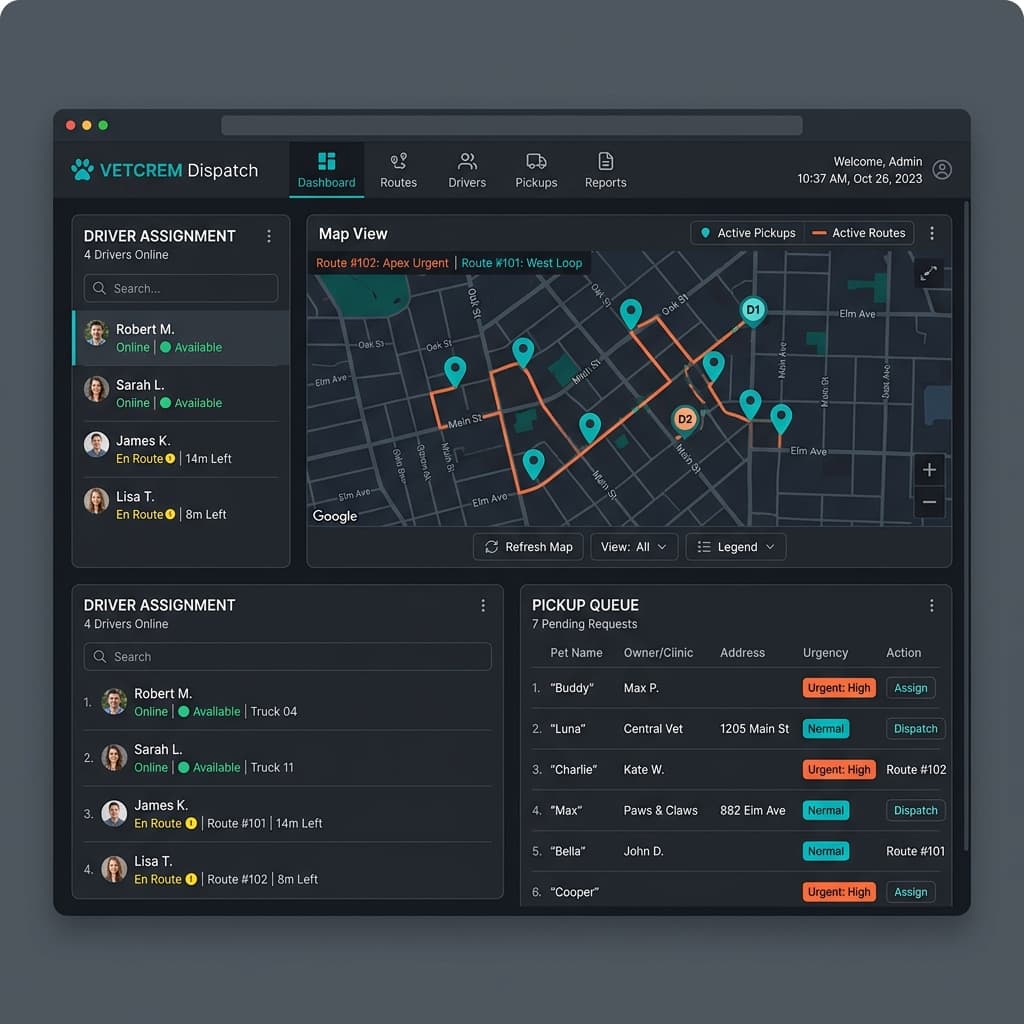
Multi-truck pet aftercare fleet management software uses GPS-based vehicle tracking, automated job assignment, territory zone management, and capacity-aware scheduling to coordinate multiple drivers simultaneously. It ensures the right driver is assigned to the right pickup based on proximity, vehicle capacity, driver certifications, and current workload — eliminating the manual coordination that caps operations at 2-3 trucks.
The system works on three layers:
Layer 1: Real-Time Vehicle Tracking
Every truck's GPS position updates every 15 seconds. The dispatcher (or the AI) always knows exactly where every driver is, whether they are en route, on-site, or returning to base.
Layer 2: Intelligent Job Assignment
When a new pickup request enters the system, the algorithm evaluates every available driver against six criteria:
- Proximity — Who is physically closest to the pickup address?
- Capacity — Does the driver's vehicle have room? (A van carrying two large dogs cannot accept a third.)
- Certification — Is the driver certified for this type of pickup? (Some require biohazard training for clinic pickups.)
- Workload — Is the driver approaching their daily limit or overtime threshold?
- Territory — Is the pickup in this driver's assigned zone, or will it pull them out of position for future jobs?
- Service level — Emergency pickups override all other criteria and go to the fastest-available driver.
Layer 3: Territory Management
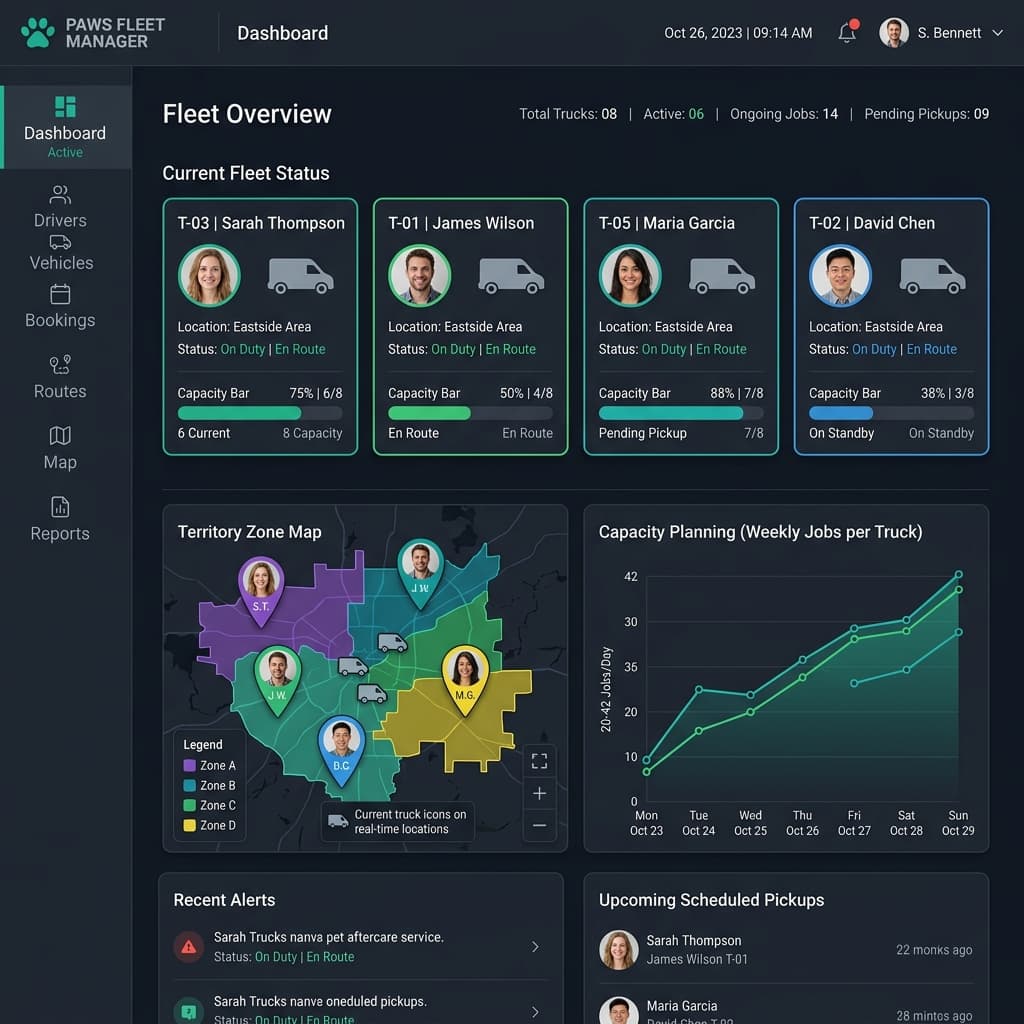
The service area is divided into zones. Each zone has a primary and secondary driver. When the primary driver is occupied, the system automatically assigns to the secondary. When both are occupied, it finds the nearest available driver from any zone and flags the territory gap for the dispatcher.
This three-layer approach means that going from 3 trucks to 5 trucks requires zero additional dispatcher headcount. The software scales linearly while the coordination complexity would otherwise scale exponentially.
Capacity Planning: Know When to Add Your Next Truck
One of the most valuable features of fleet dispatch software is predictive capacity planning. The system tracks:
- Jobs per truck per day: When your average exceeds 8 jobs/truck/day, you are approaching saturation.
- Average response time: When response times creep above 30 minutes, your coverage is insufficient.
- Territory gap frequency: When zones are left uncovered more than twice per week, you need another driver.
- Revenue per truck: When a new truck would generate more revenue than its fully-loaded cost (driver + fuel + insurance + maintenance), the math supports expansion.
The system generates a monthly capacity report that tells you, in plain language: "Based on current demand trends, you will need a 4th truck by August to maintain sub-20-minute response times in the northwest zone."
This turns fleet expansion from a gut-feeling decision into a data-driven investment.
The Driver Experience: Less Chaos, More Compassion
Fleet dispatch software does not just benefit the operator and the families. It dramatically improves the driver experience.
Without software, drivers spend 30% of their workday on non-driving tasks: checking messages, calling dispatch for their next job, looking up addresses, figuring out directions, and filling out paper forms.
With software, drivers receive:
- Push notification with the next pickup address, pet details, and family preferences
- One-tap navigation to the address with optimized routing
- Digital intake forms pre-filled with information the AI agent already collected
- Completion button that triggers the family notification and logs chain of custody
Drivers focus on what they were hired to do: providing compassionate, professional service to grieving families. The logistics happen invisibly in the background.
This also reduces turnover. Pet aftercare drivers experience emotional fatigue. Adding administrative chaos on top of emotional work is a recipe for burnout. Removing the chaos lets drivers do meaningful work without the friction.
Keep reading: