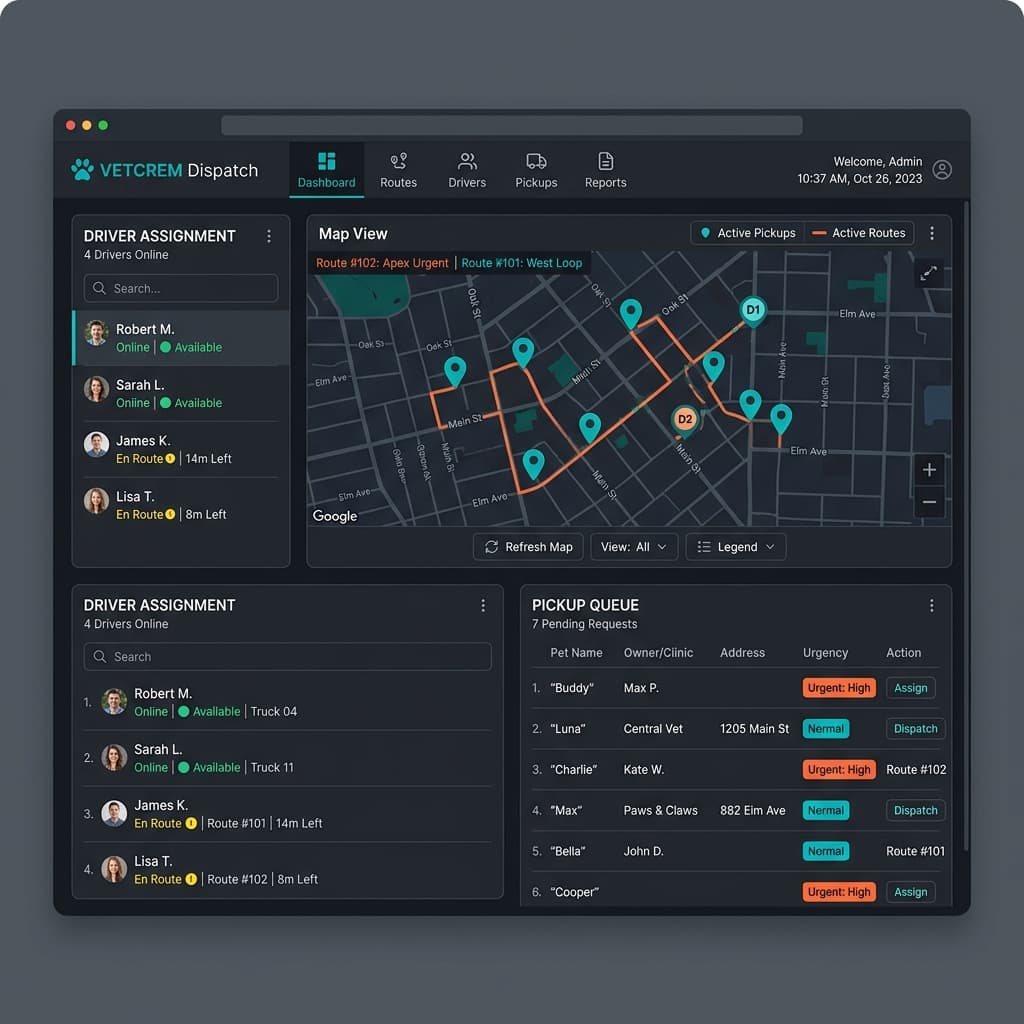
Dispatching a driver to perform a private cremation removal and accidentally recording it as a communal service is a catastrophic operational failure that will completely destroy your facility's reputation. When relying on manual paperwork, these transcription errors are inevitable. DispatchNode eliminates this liability by forcing drivers to digitally lock the requested service type into the central database at the exact moment of removal, guaranteeing absolute accuracy and protecting the integrity of the cremation process.
The Critical Distinction in Service Types
The operational requirements for a private cremation—where a single pet is placed in the retort and the specific ashes are returned to the family—are vastly different from a communal cremation. DispatchNode helps operators document and enforce the absolute separation of these workflows, ensuring that high-value private cremations are meticulously tracked while communal remains are efficiently managed for bulk processing.
A private cremation is a highly sensitive, premium service. The family is paying a significant sum to guarantee that the ashes they receive belong exclusively to their pet. This requires an unbroken, mathematically perfect chain of custody. A communal cremation, where multiple pets are cremated simultaneously and the ashes are scattered by the facility, requires significantly less granular tracking but still demands total logistical efficiency.
If a dispatcher or driver confuses these two services on a paper manifest, the result is devastating. If a private cremation is processed communally, the family's ashes are lost forever, resulting in massive lawsuits and emotional trauma. The dispatch platform completely prevents this error by hard-coding the service type into the digital work order.
When the family or the veterinary clinic requests the service through the digital portal or the AI voice agent, the specific service type (Private, Communal, or Segregated) is locked into the database. The driver cannot alter this core parameter without dual-authorization from the facility manager, ensuring that the initial request dictates the entire operational workflow.
Enforcing the Digital Chain of Custody
Paper tags are insufficient for managing the massive logistical complexity of mixed service types within a busy crematory. DispatchNode enforces a strict digital chain of custody, utilizing serialized barcode scanning to permanently link the physical remains to the specific service type logged in the database, making misidentification physically impossible.
When the driver arrives at the residence for a private cremation, the mobile app prominently displays the service type in bright red lettering. The driver must affix the serialized barcode tag to the transport bag and scan it. The app forces the driver to physically check a box confirming: "Service Verified: Private Cremation."
This scan locks the GPS coordinates, the timestamp, and the specific service type into the durable digital ledger. When the transport vehicle arrives at the crematory intake dock, the morning manager scans the barcode. The digital dashboard immediately flags the pet as a high-priority private cremation, dictating exactly where the remains should be placed in the cold storage facility to prevent mixing with communal remains.
The ultimate safeguard occurs at the retort. Before the operator initiates the burn cycle, they must scan the pet's barcode. If the operator attempts to place a private cremation pet into a communal burn cycle, the tablet emits a massive visual and auditory alarm, completely blocking the operation until the error is corrected.
Optimizing Routing Based on Service Type
Routing algorithms must account for the specific handling requirements of different service types; a driver executing a high-value private residential removal requires significantly more time on site than a driver performing a bulk communal sweep at a veterinary clinic. DispatchNode dynamically adjusts the routing matrix and ETAs based on the specific service requested, ensuring reliable execution without destroying the daily schedule.
When a grieving family requests a private residential removal, the driver must act with extreme sensitivity. They need time to speak with the family, respectfully transfer the pet, and carefully complete the digital chain-of-custody documentation. The AI routing engine automatically allocates a massive "dwell time" block for this specific stop.
Conversely, when a driver is performing a scheduled sweep at a corporate veterinary clinic to pick up ten communal cremations, the process is highly streamlined. The driver scans the barcodes rapidly and loads the vehicle. The routing engine allocates a significantly shorter dwell time for this stop.
By algorithmically differentiating the logistical requirements of each service type, the software guarantees that drivers are never rushed during a sensitive residential removal and never delayed during a high-efficiency clinic sweep. This perfect balance ensures maximum route density while protecting the high-quality, empathetic service standards of the facility.
Automated Billing and Manifesting
Billing for mixed service types using manual invoices is an administrative nightmare that frequently results in undercharging for premium services. DispatchNode automatically generates unified, perfectly accurate invoices based on the specific digital service logs, guaranteeing that the crematory captures every dollar of revenue associated with high-margin private cremations and specialized memorial products.
If a veterinary clinic requests three private cremations, four communal cremations, and two specialized paw print impressions over the course of a week, relying on a human accountant to decipher the handwritten driver logs guarantees errors. The clinic will inevitably be under-billed, or they will dispute the invoice due to poor documentation.
The digital ledger eliminates this friction entirely. Because every service type was locked into the database at the point of request and verified by the driver's barcode scans, the billing software generates a reliable, itemized invoice. It clearly separates the high-margin private cremation fees from the standard communal rates.
This automated precision protects the crematory's profit margins and dramatically accelerates the accounts receivable cycle. The corporate veterinary clinic receives a clean, undeniable digital invoice backed by perfect chain-of-custody data, ensuring rapid payment and cementing the crematory's status as a highly professional, indispensable logistics partner.
Pricing Breakdown by Cremation Type
The financial difference between private and communal cremation is substantial, and understanding the margin structure is essential for any crematory operator looking to maximize revenue per case.
| Factor | Private Cremation | Communal Cremation |
|---|---|---|
| Average Price | $200 - $450 | $50 - $100 |
| Cremation Duration | 45 - 180 min (dedicated retort) | Batched (multiple pets) |
| Urn Return | Yes (individual ashes returned) | No (ashes not returned) |
| Chain of Custody | Mandatory barcode tracking | Group-level tracking only |
| Margin per Case | 65 - 75% | 40 - 50% |
| Memorial Upsell Potential | High (urns, paw prints, jewelry) | None |
The data demonstrates why private cremation is the financial engine of any aftercare facility. A single private cremation with memorial add-ons is often a higher-margin ticket than communal service — actual revenue and margin vary widely by market and cost structure. Communal cremation serves a purpose for price-sensitive families, but it should never be the default recommendation. The AI voice agent is trained to gently present private cremation as the primary option while compassionately offering communal as an alternative.
The Private Cremation Process Flow
Families choosing private cremation deserve strong transparency about what happens to their pet's remains. The digital platform documents every step of the process, providing the family with a verifiable timeline.
The critical guarantee of private cremation is that the retort is empty before the pet is placed inside and no other remains are introduced during the cycle. The software enforces this by requiring a "retort clear" scan before the cremation can begin, making co-mingling physically impossible.
Helping Families Make the Right Decision
The AI voice agent plays a critical role in guiding the family through the decision between private and communal cremation without applying pressure. The AVMA emphasizes that end-of-life decisions should be presented with clarity, compassion, and zero commercial pressure.
- Present Both Options Clearly: The AI explains the factual differences: "With a private cremation, you will receive your pet's individual ashes in the urn you select. With communal cremation, the ashes are not returned."
- Allow Processing Time: The AI pauses after presenting the options, giving the family space to discuss and decide without feeling rushed.
- Answer Follow-Up Questions: If the family asks, "Is private really necessary?", the AI responds with facts, not sales tactics: "Many families find comfort in having their pet's ashes at home. It is entirely your personal decision."
- Handle Price Sensitivity: If cost is a concern, the AI offers payment plan options or suggests less expensive urn selections rather than defaulting to communal.
- Document the Choice: The AI records the family's decision in the digital work order, preventing any downstream errors in service execution.
This decision-support framework maximizes private cremation conversion rates while maintaining the ethical standards that protect the facility's reputation. For more on trust-building, read our guide on Building Trust with Grieving Pet Owners.
The Absolute Liability of Commingled Cremains
The foundational trust between a pet owner and a crematory rests entirely on a single, uncompromising premise: if a family pays for a private cremation, they must receive only the ashes of their specific pet. The pet cremation industry has historically suffered severe reputational damage due to unscrupulous or disorganized operators who engage in the commingling of cremains, either intentionally to save natural gas, or accidentally due to poor tracking procedures.
When a crematory violates this trust, the liability is absolute. Lawsuits stemming from commingled cremains routinely result in massive punitive damages, frequently bankrupting the independent operator and leading to immediate closure by state regulatory boards. Therefore, the operational procedures separating private and communal workflows cannot rely on the "honor system" or color-coded sticky notes; they must be digital enforced by software architecture.
Advanced dispatch and facility management platforms treat private cremations as highly secure, isolated data objects. When a pet is designated as "Private" during the initial AI intake call, the software applies a digital lock to that specific pet's barcode.
As the pet moves through the facility, the software aggressively audits its physical location. If a technician attempts to scan a "Private" pet into a retort cycle that the software knows currently contains a "Communal" batch, the system triggers a catastrophic alarm. The mobile app screen locks out, a siren sounds in the facility, and an immediate text alert is sent to the facility owner. The software physically prevents the technician from authorizing the cycle, ensuring that an exhausted employee cannot accidentally trigger a business-ending liability event. This absolute, software-enforced segregation guarantees that the integrity of the private cremation process is mathematically unquestionable.
Volumetric Yield Optimization in Communal Processing
While private cremations generate the highest margin per transaction, high-volume communal cremations—typically sourced from veterinary clinic sweeps—are the steady, foundational revenue stream that covers the fixed overhead of the facility. Communal cremations involve processing dozens of pets simultaneously, with the resulting ashes typically scattered on dedicated private land or processed at a municipal facility.
Maximizing the profitability of communal cremations requires advanced volumetric yield optimization. An operator cannot simply load a few pets into a massive retort and run a cycle; the natural gas expenditure will completely destroy the profit margin of the low-cost communal service. The retort must be operated as close to its maximum thermal and volumetric capacity as legally and safely possible.
Sophisticated software platforms automate this optimization. The system continuously aggregates the weight of all communal pets currently holding in cold storage. The algorithm knows the exact thermal capacity and optimal pound-per-hour processing rate of every specific retort in the facility.
The software acts as a loadmaster. It will advise the facility manager: "Retort A requires 450 pounds to reach optimal thermal efficiency. You currently have 380 pounds in the communal queue. Recommend delaying cycle for two hours until Driver B returns from the afternoon veterinary sweep to maximize yield." By algorithmically dictating the exact batching and timing of the communal cycles, the operator ensures they are extracting the absolute maximum profit from every cubic foot of natural gas consumed, drastically lowering their overall cost of goods sold (COGS).
The volumetric yield optimization logic also deeply integrates with the facility's utility management architecture. In regions with volatile natural gas pricing, the software can automatically cross-reference daily utility rates via municipal APIs. The algorithm will dynamically schedule massive communal runs during off-peak energy hours—frequently late at night—further depressing the operational cost-per-pound and ensuring the facility remains immensely profitable even during periods of extreme macroeconomic inflation.