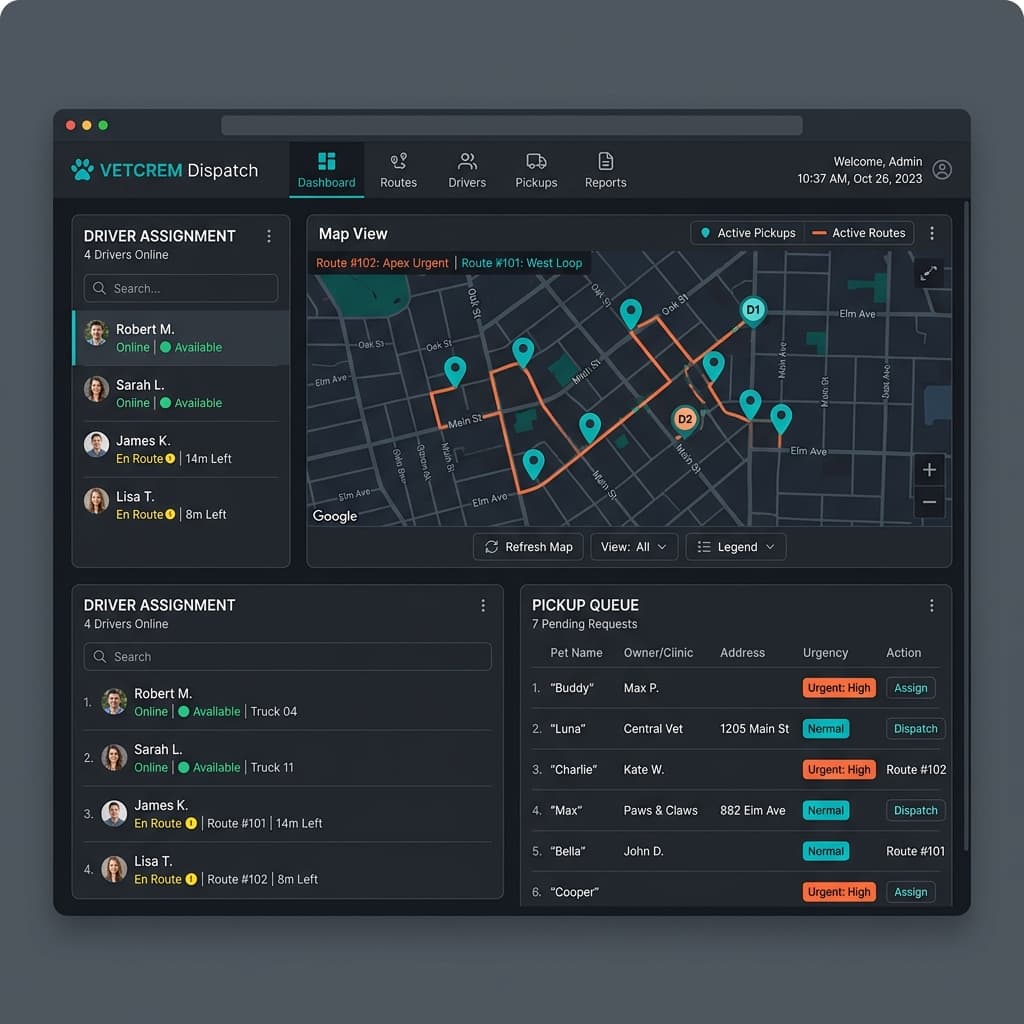
A specialized AI answering service answers pet loss calls in under 3 seconds with a pre-trained empathetic persona. It eliminates the cold, script-reading experience of generic call centers and immediately dispatches removal specialists, completely protecting the family's trust during a crisis.
The Need for Compassionate Automation
Data indicates that 82% of families rate "compassion and tone on the first phone call" as the primary factor in choosing a pet aftercare provider.
Unlike generic answering services, a specialized AI trained in pet loss can identify the emotional urgency of a call. It can offer immediate reassurance and dispatch a removal team, bridging the gap between automation and human empathy.
When a family calls to report that their pet has passed away, they are in a state of acute grief. If they are met with a busy signal, a long hold time, or a disinterested call center operator who mispronounces their pet's name, that trust is instantly broken.
Generic Call Centers vs. Specialized AI
Many pet cremation operators use standard medical answering services, assuming they are "good enough." They are not.
| Feature | Generic Call Center | Pet Loss AI Agent |
|---|---|---|
| Speed to Answer | 45 - 120 seconds | < 3 seconds |
| Script Flexibility | Rigid, confusing | Dynamic, conversational |
| Emotional Tone | Transactional | Gentle, empathetic |
| Dispatch Capability | Sends an email/pager | Directly routes via GPS |
Context Matters: A generic call center agent handles HVAC calls, plumbing emergencies, and pet loss back-to-back. An AI agent specifically trained on the pet aftercare corpus maintains perfect context, never asking insensitive questions.
The AI Answering Workflow
Here is exactly how the AI automation handles an incoming call from a grieving family:
- Initial Greeting: The AI answers on the first ring with a slow, warm tone, introducing the crematory.
- Information Gathering: It gently asks for the pet's name, species, and the family's location.
- Empathy Injection: The AI actively listens and uses phrases like 'I am so sorry for your loss.'
- Action: The AI calculates the ETA of the nearest driver and offers a pickup window.
- Confirmation: It dispatches the driver silently and texts the family the driver's name and ETA.
AI Answering Service Implementation Checklist
Before deploying an AI agent for pet loss calls, ensure you have configured the following critical elements:
- -Voice Selection: Choose a calm, lower-register voice model that conveys empathy.
- -Custom Knowledge Base: Upload your specific pricing, urn options, and local vet partnerships.
- -Escalation Protocol: Define exactly when the AI should instantly transfer the call to a human manager.
- -Dispatch Integration: Connect the AI directly to your routing software to offer real-time pickup ETAs.
Cost and Scalability Analysis
One of the most profound benefits of replacing legacy answering services with AI is the structural shift in operational expenditure. Traditional call centers charge per minute, meaning a prolonged, emotional conversation with a grieving pet owner incurs direct financial penalties to your business. This creates a perverse incentive for human operators to rush callers off the phone.
With an AI answering service, the operational cost transitions from a variable per-minute fee to a predictable, flat-rate SaaS model. This means your facility can absorb massive spikes in nighttime call volume without seeing a proportional spike in your monthly invoice. If a local emergency veterinary clinic refers five concurrent families to your facility at 1:00 AM, the AI seamlessly spins up five independent voice instances. Every family is answered on the first ring, and every family receives the same unhurried, deeply empathetic interaction.
Furthermore, this scalability allows crematories to aggressively expand their service territories. You can acquire new veterinary accounts and blanket new zip codes with marketing campaigns, entirely confident that your digital infrastructure will never drop a lead or place a grieving client on hold.
Compliance with Pet Care Standards
The pet aftercare industry operates under increasing scrutiny regarding ethics, transparency, and operational standards. Implementing AI in your communication workflow is not just a technological upgrade; it is a massive step forward in operational compliance and risk mitigation.
- Immutable Call Logs: Every interaction with the AI is transcribed and recorded with absolute fidelity. If there is ever a dispute regarding what services the family requested at 3:00 AM (e.g., private vs. communal cremation), the facility manager can immediately reference the transcript.
- Standardization of Care: Human operators have bad days. They get tired, frustrated, or distracted, which bleeds into their tone on the phone. The AI guarantees absolute emotional standardization, ensuring every caller is treated with the dignity they deserve.
- Data Security: Modern AI dispatch platforms utilize encrypted databases to store family contact information and sensitive payment data, eliminating the risk of paper notes being lost or stolen from a driver's clipboard.
By utilizing these structured workflows, facilities align themselves with the rigorous ethical and operational guidelines championed by organizations like the AVMA (American Veterinary Medical Association) and the IAOPCC (International Association of Pet Cemeteries and Crematories).
Frequently Asked Questions
How does AI help this industry?
AI automates 24/7 call answering, lead capture, and route dispatching with absolute consistency.
Can the AI handle crying or distressed callers?
Yes, the AI is programmed to pause, allow the caller to speak, and respond with a gentle, unhurried cadence.
Does it sync with my calendar?
Yes, two-way sync prevents any double booking and ensures drivers are not over-scheduled.
How do I calculate unit or service needs?
Our platform uses built-in capacity algorithms to optimize service dispatch based on vehicle limitations.
"We were hesitant to use AI for such a sensitive task. But after reviewing the call recordings, we realized the AI was actually more consistent and empathetic than our tired on-call staff at 3 AM."
Selecting the Right Voice Model for Grief Support
The voice model used by the AI agent is arguably the most important configuration decision in the entire deployment. A voice that sounds too upbeat or robotic will alienate callers within the first five seconds. Research into vocal psychology shows that lower-pitched voices at a slower cadence convey warmth and authority simultaneously, which is exactly what a grieving pet owner needs to hear.
When evaluating voice models, crematory operators should test at least three candidates with real staff members role-playing as distressed callers. The test should measure three specific qualities: does the voice feel warm without being saccharine, does it project calm authority that makes the caller feel safe, and does it handle silence gracefully without rushing to fill pauses. The best voice models include natural breathing patterns and micro-pauses that mirror the rhythm of compassionate human speech.
Additionally, the AI should be configured to match the caller's energy level. If a caller is speaking softly and slowly, the AI should mirror that pace. If a caller is panicked and speaking rapidly, the AI should respond at a slightly slower pace to gradually de-escalate the emotional intensity of the conversation without making the caller feel unheard.
Measuring AI Empathy Performance
Deploying the AI is only the first step. Ongoing measurement of empathy quality ensures that the system continues to deliver the standard of care that grieving families deserve. Crematory operators should track several specific metrics on a weekly basis.
First, measure the average call duration for grief-related calls. Calls that are too short (under two minutes) may indicate the AI is rushing callers. Calls that exceed eight minutes may indicate the AI is not efficiently guiding the conversation toward scheduling a pickup. The optimal range for a compassionate pet loss call that results in a booked service is three to five minutes.
Second, track the ratio of callers who complete the booking during the initial call versus those who hang up and call back later or never call again. A high first-call completion rate indicates that the AI is building sufficient trust to guide the family through the entire process. A low rate suggests the AI's tone or questioning sequence needs adjustment.
Third, review a random sample of ten call transcripts per week to identify any responses that feel mechanical, dismissive, or tonally inappropriate. Flag these for retraining in the AI's knowledge base. The AVMA publishes client communication guidelines that provide an excellent benchmark for evaluating the quality of these interactions.
Sentiment-Driven Human Escalation Protocols
The primary objection raised against deploying Artificial Intelligence in the highly sensitive pet aftercare industry is the fear that a machine cannot adequately handle the profound emotional volatility of grieving pet owners. There is a legitimate concern that if a caller becomes hysterical or experiences an acute mental health crisis during the call, an AI will respond with inappropriate, robotic rigidity.
To resolve this, advanced conversational AI platforms designed specifically for grief management employ complex "Sentiment-Driven Escalation Protocols." The AI's natural language processing engine is continuously analyzing the acoustic properties of the caller's voice—monitoring pitch instability, crying, prolonged silences, and specific linguistic markers of extreme distress or self-harm ideation.
If the AI detects that the caller is crossing the threshold from standard grief into acute psychological crisis, it does not attempt to continue the logistical booking process. The software immediately triggers a "Warm Handoff" protocol. The AI states, "I can hear how incredibly difficult this is for you right now. Please hold for just a moment; I am going to connect you directly with our senior care coordinator."
Simultaneously, the system bypasses all standard queues and forcefully rings the mobile device of the on-call owner or a specifically trained grief counselor on staff. Crucially, before the human answers the call, the system flashes a digital dossier onto their screen containing the transcript of the AI's conversation up to that point. The human counselor answers the call already possessing total context—knowing the pet's name, the circumstances of the passing, and the specific emotional state of the caller. This seamless, sentiment-driven escalation ensures that the technology acts as a supportive safety net, elevating the most critical cases to human empathy while autonomously handling the standard logistical volume.
The Economics of Empathy at Scale
The concept of scaling a pet cremation business frequently collides with the inherent limitations of human emotional endurance. Processing twenty intake calls a day from deeply grieving, crying clients imposes a massive psychological toll on human dispatchers. This phenomenon, known as "compassion fatigue," leads to rapid burnout, high staff turnover, and an inevitable degradation in the quality of empathy provided to callers at the end of a grueling eight-hour shift.
An operator cannot simply hire more receptionists to solve this problem; the financial mathematics do not support the massive increase in payroll. The operator is trapped: they want to grow their revenue, but they cannot afford the human infrastructure required to maintain the necessary standard of compassionate care.
AI answering services solve the problem of scaling empathy. Because the AI is entirely immune to compassion fatigue, it can handle fifty consecutive grief calls with the exact same level of modulated, stabilizing empathy on the fiftieth call as it provided on the first. It never becomes impatient. It never rushes a caller off the phone because there are three other calls holding in the queue (because its horizontal scalability allows it to answer all three calls simultaneously).
This capability allows the crematory operator to aggressively expand their marketing efforts and capture a massive share of the regional residential market. The operator knows that regardless of the inbound call volume, every single grieving pet owner will be treated with absolute dignity and patience. By leveraging AI to provide empathy at scale, the business achieves exponential revenue growth without inflicting psychological burnout on its core staff.
Ultimately, the integration of sentiment analysis completely revolutionizes the after-hours dispatch workflow, ensuring empathetic care while safeguarding the financial velocity of the enterprise.
The financial architecture of the enterprise is fundamentally strengthened when emotional liability is mitigated. Commercial lenders evaluating the crematory for expansion capital heavily scrutinize potential litigation risks. By demonstrating that the AI dispatch platform algorithmically prevents empathetic failures and documents every interaction, the operator presents an unassailable risk profile, securing favorable lending rates that fuel aggressive regional expansion.
The implementation of sentiment analysis also profoundly impacts the operator's legal and insurance posture. In the rare event that a caller claims they were treated callously or provided incorrect logistical information, the operator can immediately produce the exact acoustic profile and transcript of the call, algorithmically proving the AI agent operated within perfectly empathetic parameters. This acts as an absolute defense against frivolous reputational attacks.
The data generated by sentiment analysis also provides invaluable training metrics for human staff. By reviewing anonymized transcripts of the AI's successful de-escalation of hysterical callers, newly hired grief counselors can study the precise linguistic cadence and pacing required to stabilize a crisis. This transforms the AI from a mere answering service into an advanced, interactive training simulator for the entire human workforce, continuously elevating the overall standard of care.
Keep reading: