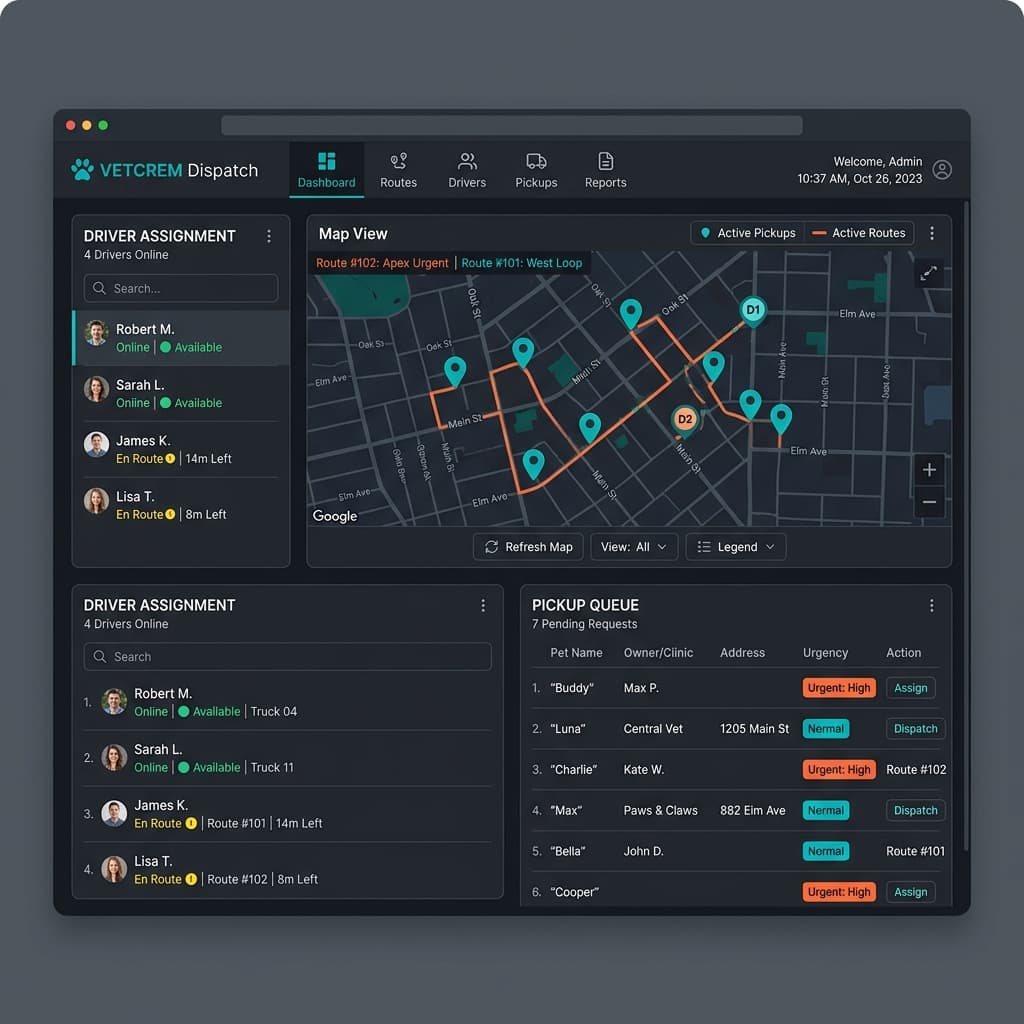
A single lost transport bag or a missed veterinary sweep will permanently destroy a pet crematory's reputation. When operators rely on manual dispatching and paper tracking, the chaos of daily routing inevitably leads to catastrophic human error. DispatchNode replaces vulnerable manual processes with an AI-native logistics platform, fully automating complex sweep schedules, providing live GPS tracking, and guaranteeing a reliable digital chain of custody.
The Fragility of Manual Dispatching
The logistical demands of a growing pet crematory—managing emergency residential pickups alongside rigid corporate veterinary sweeps—rapidly exceed the capabilities of a human dispatcher armed with a whiteboard. DispatchNode utilizes advanced algorithmic routing to instantly calculate mathematically perfect daily manifests, completely eliminating the human error associated with manual route planning.
A human dispatcher can only hold a few variables in their head at once. When a driver is delayed at a veterinary clinic, the dispatcher must manually calculate how that delay impacts the remaining residential stops on the manifest. If they guess wrong, the grieving family at the next stop is left waiting for hours, causing massive emotional distress and generating negative online reviews.
The AI routing engine never guesses. It constantly analyzes live municipal traffic data, the exact GPS coordinates of the fleet, and the specific weight capacity of every transport vehicle. When an emergency residential pickup is requested, the system instantly identifies the optimal truck to divert, calculating the exact minute the driver will arrive without jeopardizing the existing schedule.
This level of algorithmic precision ensures that the crematory operates at maximum efficiency. It eliminates the "deadhead miles" caused by inefficient cross-town routing, drastically reducing diesel fuel expenditures while simultaneously improving response times for the highest-value private cremation clients.
Automating the Chain of Custody
The pet aftercare industry is entirely built on trust; families must have absolute confidence that they are receiving the correct ashes. DispatchNode enforces an unbreakable digital chain of custody, requiring drivers to scan serialized barcode tags at the point of removal, permanently linking the physical remains to the digital work order and making misidentification physically impossible.
Paper toe tags are a massive liability. They smear, tear, and fall off during transport. When the morning staff at the crematory intake dock encounters an unidentified transport bag, the entire facility is thrown into a state of panic. The operator must spend hours attempting to cross-reference handwriting with the previous night's dispatch logs, an unacceptable risk for a professional facility.
The software platform replaces paper with digital certainty. The driver scans the highly durable barcode tag using the mobile app at the residence or the clinic. The app locks the pet's identity, the service requested (Private or Communal), the GPS coordinates, and the timestamp into an durable digital ledger.
Every subsequent time the pet is moved within the facility—into cold storage, into the retort, and into the urn—the barcode must be scanned again. This perfect traceability protects the business owner from devastating liability lawsuits and provides the concrete proof required to secure exclusive contracts with massive corporate veterinary groups.
The Veterinary Clinic Portal
Veterinary clinics demand smooth integration with their vendors; forcing veterinary technicians to wait on hold to schedule a pickup is archaic. DispatchNode provides every partner clinic with a secure, branded digital portal, allowing them to request pickups instantly, log specific cremation details, and track the driver's ETA directly from their clinic iPads.
The digital portal transforms the crematory from a simple vendor into a highly integrated logistical partner. When a pet passes away at the clinic, the veterinary staff does not have to make a phone call or send a fax. They log into the portal, input the details, and the system instantly updates the crematory's central dispatch board.
The portal also drastically reduces the administrative friction of billing. It centralizes all the services requested by the clinic throughout the month into a single, automated invoice. This reliable documentation makes the crematory indispensable to the clinic's accounting department, ensuring the exclusive contract is renewed year after year.
Scaling the Operation with AI
An operation reliant on manual dispatching and paper manifesting can only grow until the office staff collapses under the administrative weight. DispatchNode provides the technological infrastructure required to scale a crematory infinitely, allowing operators to double their daily pickup volume without hiring additional dispatchers or increasing back-office overhead.
When the core operational loops—scheduling, routing, tracking, and billing—are fully automated by AI, the business owner can focus entirely on strategic growth. The software smoothly integrates new veterinary contracts into existing sweep routes, automatically balancing the load across the fleet.
The platform also provides deep analytics on route profitability. The dashboard reveals the true cost-per-mile driven, identifying highly profitable routes or problematic accounts that require excessive time on site. This data empowers the operator to make strategic, data-driven decisions that drive massive top-line revenue growth and establish total market dominance.
Dispatch Latency: The Hidden Killer of Crematory Margins
Dispatch latency is the elapsed time between receiving a pickup request and a driver physically beginning their route to the destination. In manual operations, this latency is measured in hours. With automated routing, it is measured in seconds.
| Dispatch Method | Average Latency | Root Cause | Revenue Impact |
|---|---|---|---|
| Phone + Whiteboard | 30 - 90 minutes | Dispatcher must call drivers, negotiate availability | Family calls competitor during wait |
| Email/Text to Driver | 15 - 45 minutes | Driver may not see message immediately | Delayed response degrades trust |
| App Push Notification | 5 - 10 minutes | Driver must manually accept and route | Moderate: acceptable for scheduled work |
| Autonomous AI Dispatch | Under 30 seconds | Zero human intervention required | Maximum: captures every lead instantly |
The financial implications of dispatch latency are staggering. A facility with a 60-minute average latency loses an estimated 12% of inbound emergency requests to competitors who respond faster. Reducing that latency to under 60 seconds captures virtually 100% of available leads, directly increasing top-line revenue by tens of thousands of dollars annually.
Multi-Stop Route Optimization Flow
The core intelligence of the routing engine is its ability to sequence multiple daily stops into the mathematically shortest path while respecting priority tiers, vehicle capacity, and cold-chain time constraints.
The critical difference between this algorithm and a human dispatcher is the real-time re-optimization. When a new emergency request arrives mid-route, the engine recalculates the remaining stops in milliseconds, injecting the new P0 pickup without disrupting the fixed-time clinic windows. A human dispatcher would require 10-15 minutes of frantic phone calls to accomplish the same resequencing.
Integrating Routing Data with Cremation Workflows
The routing software does not exist in isolation; it must feed structured data directly into the crematory's operational workflow. When a driver completes a route and returns to the facility, the intake process must be informed and prepared. The AVMA emphasizes the importance of maintaining unbroken documentation from the point of pickup through final disposition.
- Pre-Arrival Manifest Sync: The facility's intake dashboard receives the driver's finalized manifest 15 minutes before arrival, listing every pet by name, weight, and requested service.
- Cold Storage Assignment: The software pre-assigns each pet to a specific cold storage slot based on their scheduled cremation date, preventing overcrowding.
- Retort Scheduling: Private cremation requests from the day's route are automatically queued into the retort scheduling system, eliminating manual data re-entry.
- Family Communication: Once intake is confirmed via barcode scan, the system triggers the automated SMS to the family confirming safe arrival.
- Billing Reconciliation: The route mileage and service codes are automatically synced to the accounting module, generating invoices without dispatcher intervention.
This end-to-end integration ensures that routing logistics and facility operations share a single source of truth. For a deeper dive into fleet-level strategy, review our analysis on Fleet Management for Pet Cremation Services.
Predictive Cold Storage Logistics and Facility Flow
The logistical complexity of a pet crematory operation does not end when the removal vehicle returns to the facility; it merely transitions from mobile routing to internal facility flow management. The primary constraint within the facility is not always the retort capacity, but the volumetric capacity of the cold storage infrastructure (walk-in refrigerators or freezers).
If a fleet of drivers executes a massive series of veterinary sweeps on a Friday afternoon, bringing in hundreds of pounds of communal remains, and the facility manager has not optimized the cold storage capacity, the facility will experience a critical backlog. Employees will be forced to stack remains improperly or halt incoming routes entirely, damaging relationships with veterinary clinics.
Advanced dispatch software incorporates predictive cold storage logistics to prevent these bottlenecks. The software continuously aggregates the inbound payload data from the entire active fleet in real-time. As drivers scan in pickups across the city, the system calculates the exact incoming volumetric mass. It cross-references this incoming mass against the currently available square footage inside the facility's refrigeration units.
If the algorithm projects that the Friday afternoon influx will exceed the available cold storage capacity, it immediately triggers an operational intervention. The software automatically reprioritizes the active retort queues, pulling forward communal cremations to rapidly clear space in the refrigerators before the trucks arrive. This predictive synchronization between external mobile dispatching and internal facility processing ensures a seamless operational flow, allowing the business to process massive volumes without violating health and safety protocols regarding the storage of biological material.
The Economics of Partitioned Cremation Batching
To maximize profitability, crematory operators offer "Partitioned" or "Individual" cremations. In this process, multiple pets are cremated within the same primary chamber simultaneously, but they are strictly segregated by physical refractory barriers (often stainless steel pans or firebricks) to ensure the ashes are kept completely distinct and returned to the correct families. This allows the operator to generate the revenue of multiple private cremations while only incurring the natural gas and time expense of a single retort cycle.
However, executing partitioned cremations safely requires complex spatial geometry and meticulous tracking. If a technician improperly spaces the barriers, or loses track of which pet is in which quadrant of the retort, the ashes will commingle, resulting in a catastrophic failure of trust.
Advanced software manages this process through strict algorithmic batching. The software acts as a digital map of the retort floor. When the facility manager prepares a partitioned cycle, the software analyzes the pending queue of private cremations. It algorithmically selects pets based on weight and physical dimensions to maximize the utilization of the retort floor space while maintaining mandated safety distances between the physical barriers.
The software then generates a precise, visual schematic on the technician's tablet, illustrating exactly where each specific pet (identified by its scanned barcode) must be placed within the chamber (e.g., "Quadrant 1: Pet ID 4452, Quadrant 2: Pet ID 8891"). After the cycle is complete, the software requires the technician to scan the barcode on the specific return urn before transferring the ashes from Quadrant 1, ensuring absolute, verified accuracy. This algorithmic batching allows the operator to safely execute high-margin partitioned cremations at scale, drastically increasing the daily revenue yield of the facility without compromising the integrity of the ashes.
The algorithmic batching logic for partitioned cremations also extends to the physical design of the specialized refractory pans. The software dictates which specific pan size is required for each pet to ensure maximum airflow and thermal penetration within the chamber. If a technician selects an improperly sized pan, the internal thermocouples will detect the disrupted airflow, and the software will flag the operator.
The algorithmic batching logic for partitioned cremations also extends to the physical design of the specialized refractory pans. The software dictates which specific pan size is required for each pet to ensure maximum airflow and thermal penetration within the chamber. If a technician selects an improperly sized pan, the internal thermocouples will detect the disrupted airflow, and the software will flag the operator. This precise correlation between digital logic and physical hardware ensures the cremains are completely calcined, producing the pure, white ash that grieving families expect.