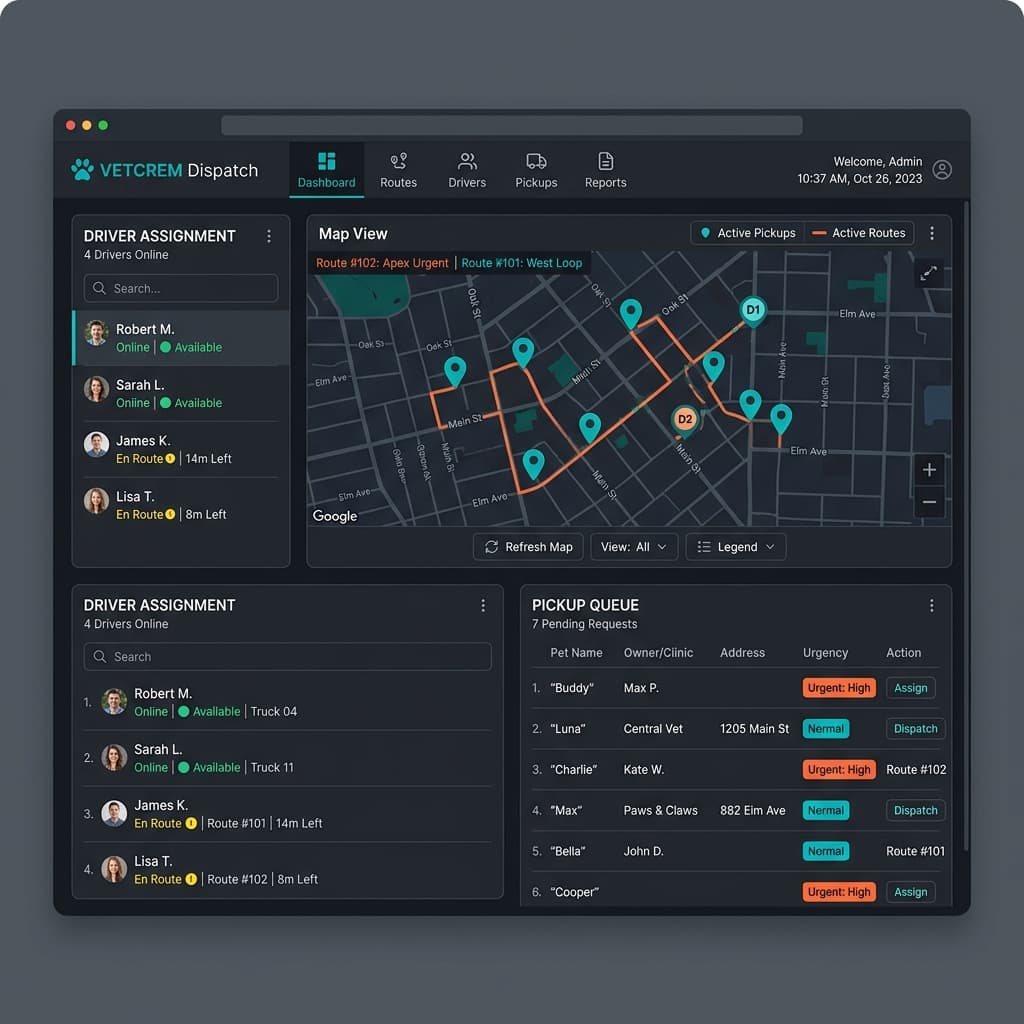
A single instance of returning the wrong ashes to a grieving family will completely destroy a crematory's reputation and trigger devastating lawsuits. Relying on handwritten paper tags and verbal communication in a busy facility guarantees that a catastrophic misidentification will eventually occur. DispatchNode completely eliminates this liability by enforcing an unbreakable, digitally documented digital chain of custody that tracks every single movement of the pet from the initial pickup to the final return of the urn.
The Liability of Paper Tracking
Paper tracking systems are inherently fragile; tags get wet, handwriting is illegible, and clipboards are easily lost in a chaotic crematory environment. DispatchNode replaces this fragile system with serialized barcode scanning and mobile applications, forcing technicians to digitally validate the identity of the pet at every single critical juncture of the cremation process.
When a driver relies on a sharpie and a paper toe tag, they are creating a massive vulnerability. If the tag falls off the transport bag while in the cold storage facility, the morning staff is faced with an unidentified pet. This completely halts operations and forces the staff to guess the pet's identity based on size and breed, which is an absolutely unacceptable risk when dealing with private cremations.
The AI-native platform eliminates the paper tag entirely. The driver utilizes highly durable, serialized barcode or RFID tags. At the moment of removal, the driver scans the tag using their tablet and inputs the pet's specific details—name, breed, weight, and the family's contact information. This scan locks the data into the central digital ledger, associating that specific physical tag with the durable digital record.
Once the tag is scanned, it becomes the absolute source of truth. The system will not allow any service to be performed without the tag being successfully scanned and validated against the scheduled work order. This rigid protocol protects the business from human error and guarantees the integrity of the entire operation.
Scanning at Every Transfer Point
A true chain of custody requires a continuous, unbroken record of possession. DispatchNode helps operators document and enforce the crematory staff to scan the pet's barcode every time physical custody changes hands or a new process begins, creating a timestamped, GPS-verified ledger that tracks the exact location and status of the remains at all times.
The chain of custody must document the journey from the home, to the transport vehicle, to the intake facility, into the retort, and finally into the urn. When the driver arrives at the crematory, the intake manager must scan the barcode to officially accept the remains. This scan updates the digital dashboard, alerting the management team that the pet is now securely in the facility.
The most critical scan occurs at the retort. Before the operator places the pet into the cremation chamber for a private cremation, they must scan the tag. If the system detects that the pet was scheduled for a communal cremation instead of a private one, the tablet emits a massive visual and auditory warning, completely preventing the irreversible error of performing the wrong service.
This forced validation removes the burden of memory from the retort operator. They do not have to double-check the clipboard; the software enforces the protocol. Once the cremation is complete, the tag must remain with the ashes until they are placed into the specific urn selected by the family. A final scan links the physical urn to the completed digital record.
Generating the Certificate of Cremation
Families paying premium rates for private cremation demand strong proof that the service was performed with integrity. DispatchNode utilizes the timestamped chain-of-custody data to automatically generate a digitally signed Certificate of Private Cremation, providing the family with documented evidence that their specific pet was honored according to their wishes.
A generic certificate printed on fancy paper means nothing if it is not backed by data. The software-generated certificate includes the exact times the pet was received, when the cremation began, and when it was completed, alongside the digital signature of the specific retort operator who oversaw the process.
This extreme level of detail is profoundly comforting to the grieving family. It removes all doubt and suspicion. When the family receives the urn alongside this comprehensive digital ledger, they realize they chose a highly professional, profoundly respectful facility. This transparency is the single most powerful marketing tool in the pet aftercare industry.
Furthermore, if a veterinary clinic ever questions the crematory's processes, the facility can instantly pull up the digital chain of custody for any specific pet, proving their operational integrity and securing the veterinary contract against any competitor attempting to undercut them on price.
Protecting the Business from Liability
In the highly emotional death care industry, accusations of mishandling remains are common and legally disastrous. DispatchNode provides the crematory owner with the ultimate legal shield; the durable digital ledger proves exactly what happened, when it happened, and who executed the process, completely neutralizing fraudulent claims or emotional accusations.
If a family, in the depths of their grief, becomes convinced that the ashes they received are not their pet, they may threaten a lawsuit. If the crematory relies on paper records, it is a battle of their word against the family's emotions, which is a terrible position in court or the court of public opinion.
With DispatchNode, the owner simply opens the digital record. They can demonstrate the exact scan timestamps, the GPS coordinates of the pickup, and the digital signature of the operator. The data provides an strong defense. It proves that the facility followed a mathematically rigorous, software-enforced protocol that makes misidentification physically impossible.
By implementing digital chain-of-custody software, pet crematories protect their financial valuation, secure their community reputation, and provide the strong highest level of respectful service to grieving families. It transitions the business from a high-risk operation into a fully secured, highly professional logistics enterprise.
Comparative Tracking Technologies
When implementing a chain-of-custody system, facility operators must choose the appropriate physical tracking medium. The decision directly impacts scanning speed, error rates, and operational overhead.
| Tracking Medium | Data Density | Scanning Speed | Durability (Heat/Water) | Cost per Unit |
|---|---|---|---|---|
| Handwritten Paper Tags | Very Low | Slow (Manual entry) | Extremely Low | < $0.05 |
| Printed Barcodes (1D/2D) | High | Fast (< 1 second) | Moderate (Requires laminate) | $0.15 |
| RFID (Radio Frequency) | Very High | Instant (Proximity) | High | $0.80 - $1.50 |
| NFC (Near Field) | Very High | Instant (Tap) | High | $1.00+ |
For most high-volume crematories, Printed 2D Barcodes (QR) offer the perfect balance of low unit economics and high data integrity. RFID is incredibly powerful for massive facilities but often introduces unnecessary hardware costs for independent operators. For further discussion on software integrations, review our guide on Crematory Routing Logistics.
The Cryptographic Scan Sequence
To prove strong integrity, the software must do more than just record a barcode scan; it must digital lock that scan to a timestamp and a GPS coordinate.
If a scan occurs out of logical order (e.g., an intake scan happens before a pickup scan), the system instantly flags an anomaly, preventing the remains from proceeding to the retort until a manager intervenes.
Implementing Digital Custody in Your Operation
Transitioning from an analog clipboard to a digital ledger requires strict adherence to standard operating procedures. To guarantee a reliable deployment, execute the following steps:
- Procure Rugged Hardware: Purchase heavy-duty, waterproof mobile devices or tablets for the removal vehicles to ensure scanning capabilities never go offline in adverse weather.
- Select the Tagging Medium: Order high-durability, tear-resistant barcode tags that can withstand cold storage moisture.
- Establish "Hard Stops": Program the software to physically prevent the printing of cremation certificates if the chain of custody shows any missed scans.
- Train the Staff: Conduct a full-day seminar explaining that a missed scan is a fireable offense, as it compromises the entire legal integrity of the business.
- Comply with State Regulations: Ensure your digital reporting metrics satisfy the documentation requirements mandated by your state's veterinary and environmental boards, often modeled after EPA regulations.
By implementing these strict, digital guardrails, your facility completely insulates itself against liability and builds unbreakable trust with the community.
Immutable Ledger Technology in Cremation Tracking
The standard methodology for tracking pets through the cremation process involves a whiteboard, a stack of manila folders, and stainless-steel ID tags. This manual process is highly susceptible to human error. A tired technician can easily misplace a folder or mistakenly swap tags between two similar-looking black labradors. When a mix-up occurs, the emotional devastation inflicted on the families is catastrophic, and the resulting lawsuits and media exposure can instantly destroy the crematory's business.
To eliminate this existential risk, sophisticated operators are abandoning paper tracking entirely and implementing systems built on the principles of durable ledger technology. While not necessarily utilizing blockchain, these dispatch platforms utilize an append-only database architecture. Once a data entry is logged in the chain of custody, it cannot be deleted or altered without leaving a permanent, auditable digital footprint.
The physical tracking is executed via tamper-evident, serialized barcodes or RFID tags attached to the pet at the exact moment of residential pickup or veterinary clinic transfer. From that millisecond forward, every single physical movement of the pet requires a corresponding digital scan by an authorized employee using a managed mobile device.
If technician 'A' moves the pet from Refrigeration Unit 3 to Retort B, they must scan the pet's tag, scan the barcode on the retort door, and input their unique employee PIN. The software instantly logs the timestamp, the location, and the specific human responsible for the movement. If a family later questions whether they received the correct ashes, the operator can generate a comprehensive "Chain of Custody Dossier" detailing every single interaction, location transfer, and employee touchpoint with absolute mathematical certainty.
Automated Auditing and Compliance Verification
Maintaining a reliable chain of custody requires more than just logging data; it requires active, automated auditing to catch procedural deviations before they result in a critical error. In a high-volume crematory processing dozens of pets daily, a manager cannot manually verify every single tag transfer.
Advanced dispatch software acts as an active, tireless auditor. The system is programmed with strict workflow constraints based on the facility's Standard Operating Procedures (SOPs). For example, the SOP might dictate that a pet scheduled for a private cremation cannot be placed into the holding queue for a communal retort.
If a technician accidentally scans a private-cremation pet and attempts to assign it to a communal retort cycle in the software, the system executes a "Hard Stop." The mobile application screen flashes red, an audible alarm triggers, and the software absolutely refuses to authorize the cycle. The technician is physically prevented from making the error.
Furthermore, the system can perform automated end-of-day reconciliation. At 11:00 PM, the software cross-references the list of all pets received that day against the physical locations logged in the database. If the software shows fifty pets received, but only forty-nine pets securely logged into either a retort or a refrigeration unit, it instantly sends a critical alert to the facility manager. This automated auditing ensures that no pet is ever "lost in the shuffle," guaranteeing total operational integrity and providing the operator with absolute confidence in their compliance posture.
This digital ledger provides strong transparency, eliminating operational friction, securing client trust, and guaranteeing long-term enterprise sustainability in a highly scrutinized industry sector.
Furthermore, the digital ledger empowers the operator to offer premium, verified transportation services for highly sensitive commercial accounts, such as research universities or specialized police canine units. These high-profile clients require absolute documentation. By providing a secure portal into the durable chain of custody, the independent operator completely dominates this lucrative, specialized niche market, locking out less sophisticated competitors.
The integration of the durable ledger with public-facing APIs also provides immense value to commercial veterinary partners. Clinics can seamlessly integrate the crematory's tracking data directly into their own patient management systems, offering their clients absolute visibility without ever having to call the crematory for a status update, drastically reducing administrative friction for the clinic.
The durable ledger also provides the foundation for "Open-Door" facility tours. Because the operator possesses absolute confidence in their digital tracking and physical segregation protocols, they can confidently offer veterinary clinic managers and skeptical pet owners complete tours of the retort floor. Allowing a client to visually inspect the meticulous, scanner-driven workflow completely demystifies the cremation process. This radical transparency, backed by undeniable digital enforcement, converts hesitant veterinary clinics into exclusive, high-volume B2B partners.