Running a fleet of pet transport vehicles without intelligent management software results in excessive fuel costs, rapid vehicle depreciation, and chaotic routing. When dispatchers cannot view the real-time location and physical capacity of every truck, they make blind assignments that destroy efficiency. DispatchNode provides complete fleet management visibility, utilizing GPS tracking and capacity modeling to ensure every crematory vehicle operates at absolute maximum profitability.
The Blind Dispatch Problem
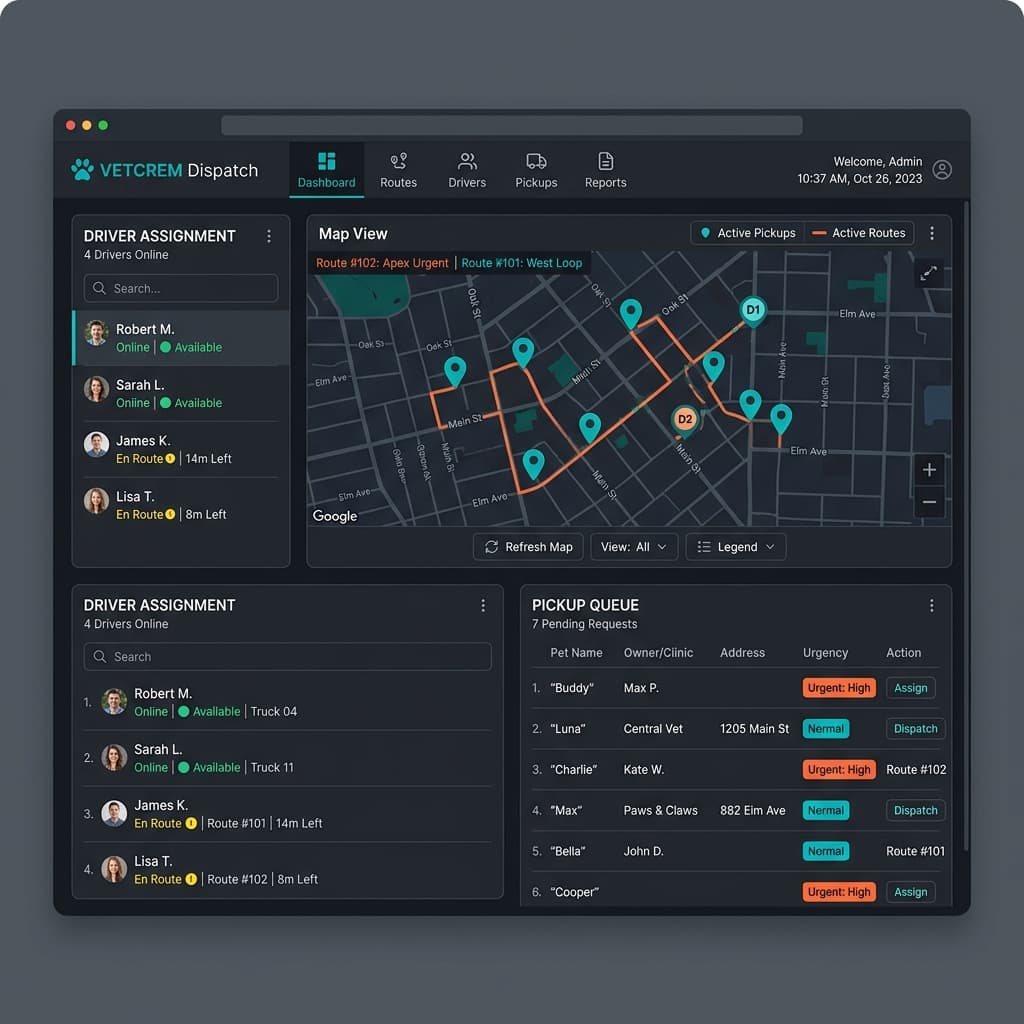
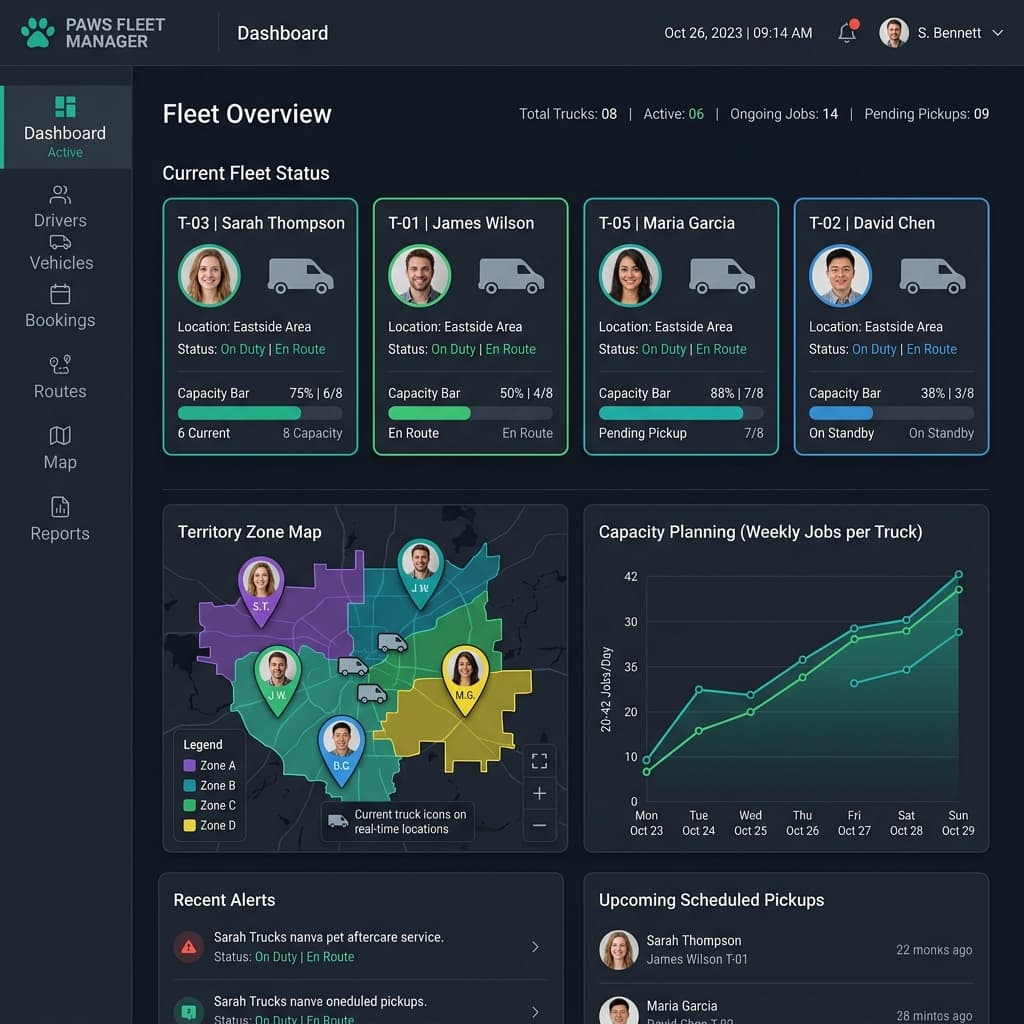
A dispatcher attempting to route five transport vehicles using only a whiteboard and text messages is essentially flying blind. They must constantly interrupt drivers to ask for their location and available capacity, causing massive delays and driver frustration. DispatchNode eliminates this friction by providing a live, centralized dashboard that tracks the exact GPS coordinates, speed, and current payload of every active vehicle in the fleet.
When a high-priority residential pickup request comes in, the dispatcher must make a split-second decision. If they guess incorrectly and assign the job to a driver who is actually stuck in traffic on the other side of town, the grieving family is forced to wait hours. The live fleet dashboard prevents this guessing game.
The dispatcher simply glances at the screen. The software clearly displays the location of all five vehicles on a live map. It goes further by integrating the driver's current status: "Driver A is actively performing a sweep at Clinic X. Driver B is empty and returning to the facility." This total operational awareness allows the dispatcher to execute the perfect assignment instantly, completely eliminating unnecessary cross-town driving.
This real-time visibility is also critical for driver safety and accountability. If a vehicle remains stationary for an abnormal amount of time in a residential neighborhood, the dispatcher is alerted automatically. They can contact the driver to ensure they are not experiencing a mechanical breakdown or facing an issue with the client, ensuring the safety of both the staff and the remains in their custody.
Dynamic Capacity Tracking
Unlike standard delivery vehicles, pet transport vehicles have highly specific, non-negotiable physical capacity constraints. Attempting to force a large breed pickup into a van that is already full of veterinary sweeps is disrespectful and physically impossible. DispatchNode models the exact volumetric capacity of every specific vehicle, actively preventing dispatchers from assigning impossible routes.
Every vehicle in the crematory's fleet is distinct; a large customized sprinter van has a vastly different capacity than a small SUV used for rapid residential response. The software allows the management team to configure the maximum payload for each specific vehicle.
As the driver executes their daily manifest—scanning barcodes at clinics and residences—the software calculates the cumulative weight and spatial footprint of the remains currently loaded in the vehicle. The dispatcher's dashboard displays a live "Capacity Metre" for every truck. If an SUV reaches eighty percent capacity, the system automatically removes it from the pool of available vehicles for large-breed pickups.
This algorithmic constraint is vital. It guarantees that a driver never arrives at a veterinary clinic or a grieving family's home and is forced to admit they do not have room in their vehicle. It ensures that the removal process remains dignified, professional, and flawlessly executed, completely protecting the reputation of the crematory.
Optimizing the Crematory Intake Flow
If all five transport vehicles return to the crematory facility at the exact same time, the intake dock becomes a massive, chaotic bottleneck. Drivers are forced to wait while the staff scrambles to scan and log the remains into the cold storage facility. DispatchNode prevents this bottleneck by sequencing the return routes, ensuring a smooth, staggered flow of intake that maximizes facility efficiency.
The crematory intake process requires meticulous attention to detail. Every barcode must be scanned, and every pet must be properly logged into the digital ledger before being placed in storage. If the staff is suddenly hit with fifty pets from five different drivers simultaneously, the risk of a scanning error or misidentification skyrockets.
The routing algorithm analyzes the progress of the entire fleet. If it detects that three drivers are scheduled to finish their manifests and return to the facility within a ten-minute window, it dynamically adjusts the routing. It might assign a low-priority residential pickup to one driver to delay their return, ensuring a staggered arrival time at the intake dock.
Furthermore, the system provides the facility staff with a predictive intake dashboard. The staff can see exactly which trucks are returning, their ETAs, and exactly how many pets they are carrying. This allows the manager to prepare the cold storage space and ensure enough staff are present on the dock to process the intake smoothly and error-free.
Maintenance and Asset Protection
Transport vehicles are highly customized, incredibly expensive assets; neglecting their maintenance destroys the financial valuation of the crematory. DispatchNode tracks the total mileage and operational hours of every vehicle, automatically generating preventive maintenance alerts for oil changes, brake inspections, and refrigeration unit servicing, ensuring the fleet remains fully operational and legally compliant.
A breakdown of a transport vehicle is a logistical nightmare. If a refrigerated van breaks down on the highway during the summer while fully loaded, the crematory faces a catastrophic situation. The remains are compromised, the schedule is destroyed, and the business's reputation is in severe jeopardy.
The software prevents breakdowns by enforcing strict maintenance schedules. Because the system tracks the vehicle's GPS movement, it knows exactly how many miles have been driven. When a van approaches its scheduled maintenance interval, the system flags it on the dispatcher's dashboard, preventing the vehicle from being assigned to long-distance or heavy-payload routes until the service is completed.
By utilizing software to track capacity, optimize intake flow, and enforce strict vehicle maintenance, the crematory owner transitions from a chaotic reactive state into total operational control. They maximize the lifespan of their highly expensive fleet assets while delivering perfectly reliable, highly dignified service to every client in their territory.
Cost-Per-Mile Benchmarking by Vehicle Class
Without granular fleet analytics, crematory owners have no idea which vehicles are profitable and which are silently draining their margins. The fleet management system must track cost-per-mile across every vehicle class to inform purchasing decisions.
| Vehicle Class | Avg. Cost per Mile | Payload Capacity | Ideal Use Case |
|---|---|---|---|
| Refrigerated Sprinter Van | $1.35 | 20+ pets (mixed) | High-volume clinic sweeps |
| Full-Size SUV (Modified) | $0.82 | 3 - 5 pets (large breed max) | Rapid residential response |
| Compact Sedan | $0.48 | 1 - 2 pets (small breed only) | Urban single pickups |
| Box Truck (Cold Storage) | $1.90 | 40+ pets | Inter-facility transfers |
When a crematory owner discovers that their refrigerated sprinter costs $1.35/mile but their compact sedan costs $0.48/mile, the fleet strategy becomes clear: deploy the sedan for all single-pet urban pickups and reserve the sprinter exclusively for multi-stop clinic sweeps where the high payload justifies the fuel cost. This data-driven fleet allocation is impossible without automated per-vehicle tracking.
Vehicle Lifecycle and Replacement Planning
Specialized transport vehicles have a finite economic lifespan, and the Department of Transportation (DOT) mandates specific inspection and certification requirements for commercial vehicles operating above certain weight thresholds. Proactive lifecycle planning prevents catastrophic mid-route breakdowns.
- Mileage Thresholds: Flag any vehicle approaching 150,000 miles for a comprehensive pre-purchase assessment to determine whether repair or replacement is more cost-effective.
- Refrigeration Unit Servicing: Schedule compressor inspections every 10,000 miles to prevent the catastrophic failure of the cold storage system during a loaded route.
- Brake and Tire Audits: Mandate quarterly inspections given the frequent stop-and-go driving pattern of crematory transport vehicles operating in residential neighborhoods.
- Insurance Premium Optimization: Vehicles with verified maintenance logs command lower commercial insurance premiums, directly reducing the facility's monthly overhead.
- Resale Value Protection: A vehicle with a complete digital maintenance history retains significantly higher resale value when it reaches end-of-life, recovering capital for fleet reinvestment.
By tracking these lifecycle metrics in the fleet dashboard, the crematory owner transitions from reactive crisis management to proactive financial planning.
Fleet Utilization Optimization Flow
To understand how the fleet management system maximizes the utilization of every vehicle on any given day, consider the algorithmic decision tree the routing engine executes:
This automated decision tree ensures that the dispatcher never assigns a job to a vehicle that cannot physically or logistically handle it. The algorithm considers capacity, proximity, priority, and cold-chain time limits simultaneously—a calculation no human dispatcher can perform with the same speed or accuracy. For a deeper look at routing intelligence, read our guide on AI Dispatch for Pet Crematories.
Telemetry-Driven Asset Depreciation Modeling
A pet crematory fleet is comprised of highly specialized vehicles. Unlike generic delivery vans, these vehicles often require significant custom upfitting: sealed bulkheads, reinforced suspension systems to handle dense weight loads (particularly for large canine communal pickups), and specialized heavy-duty liftgates or winches. This specialized upfitting drastically increases the initial capital cost of the asset. Therefore, managing the depreciation and operational lifecycle of these vehicles is a critical financial imperative for the business owner.
Traditional fleet management relies on generic mileage milestones: replacing tires every fifty thousand miles, or selling the vehicle after five years. This generic approach fails to account for the specific operational wear and tear generated by crematory routes. A removal vehicle operating exclusively in dense urban environments experiences massive brake degradation and transmission wear due to stop-and-go traffic, despite accumulating relatively low overall mileage.
Advanced fleet management software, integrating directly with the vehicle's OBD-II datalink, replaces generic guesswork with precise, telemetry-driven depreciation modeling. The software tracks "engine idle hours" just as closely as mileage. Crematory drivers frequently leave vehicles idling during residential pickups to maintain optimal cabin temperatures for the grieving families during the intake process, or while operating hydraulic liftgates. High idle hours devastate engine longevity without ever registering on the odometer.
By aggregating this granular telemetry—idle hours, hard braking events, payload weight stresses—the software calculates a customized "True Depreciation Curve" for every single vehicle in the fleet. This allows the financial officer to accurately predict exactly when a specific van will become a maintenance liability, optimizing the capital expenditure cycle to sell the asset on the secondary market before it requires a catastrophic engine replacement, thereby maximizing the total return on the specialized capital investment.
Payload Verification and Gross Vehicle Weight Compliance
The legal and safety implications of payload management in the pet cremation sector are frequently underestimated. A high-volume driver executing an end-of-week veterinary clinic sweep can easily accumulate several thousand pounds of communal remains. If the driver is operating a standard three-quarter-ton cargo van, they can unknowingly exceed the Gross Vehicle Weight Rating (GVWR) established by the manufacturer and the Department of Transportation.
Operating a vehicle over its GVWR is a massive liability. It severely compromises the vehicle's braking distance and handling dynamics, drastically increasing the probability of a fatal accident. Furthermore, if an overloaded vehicle is involved in an accident, commercial insurance carriers will routinely deny coverage, and the business owner can face severe civil or even criminal negligence charges.
Advanced dispatch platforms eliminate this critical liability through automated payload verification. The software maintains the exact curb weight and maximum payload capacity for every specific VIN in the fleet. As the driver executes their route, scanning in private and communal pickups, the software continuously calculates the aggregate weight currently sitting in the cargo area.
If a driver is scheduled to pick up a two-hundred-pound mastiff, but the software calculates that the addition of that weight will push the vehicle to ninety-eight percent of its maximum GVWR, the system executes an automated intervention. It prevents the driver from accepting any further communal sweep pickups, automatically rerouting them back to the retort facility to offload, and instantly reassigns the remaining clinic sweeps to a different vehicle with available capacity. This algorithmic oversight completely removes the burden of mathematical weight calculation from the stressed driver, guaranteeing absolute legal compliance and shielding the enterprise from catastrophic liability.