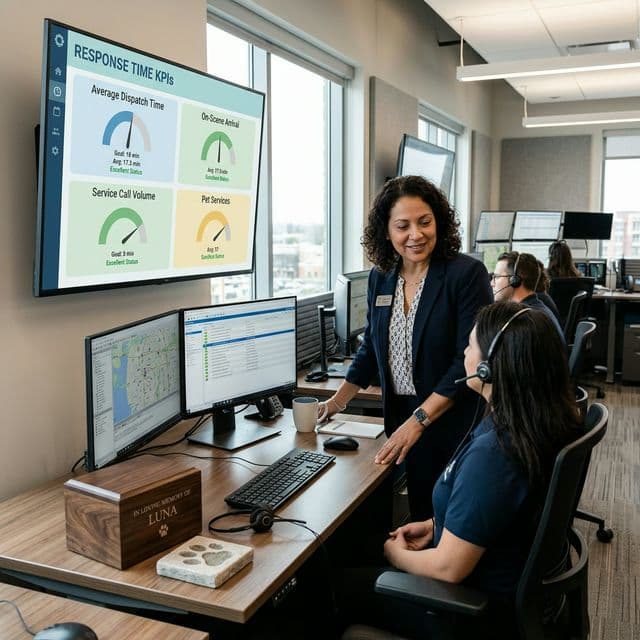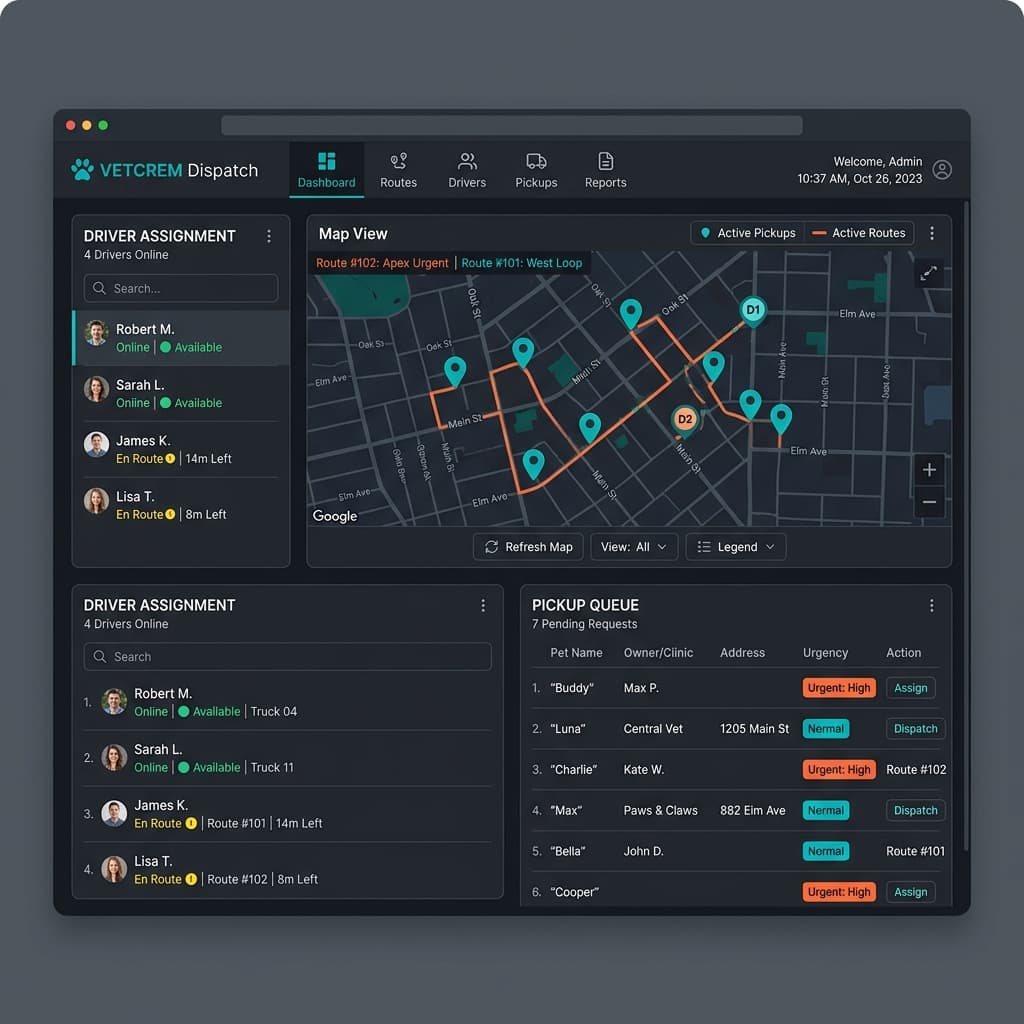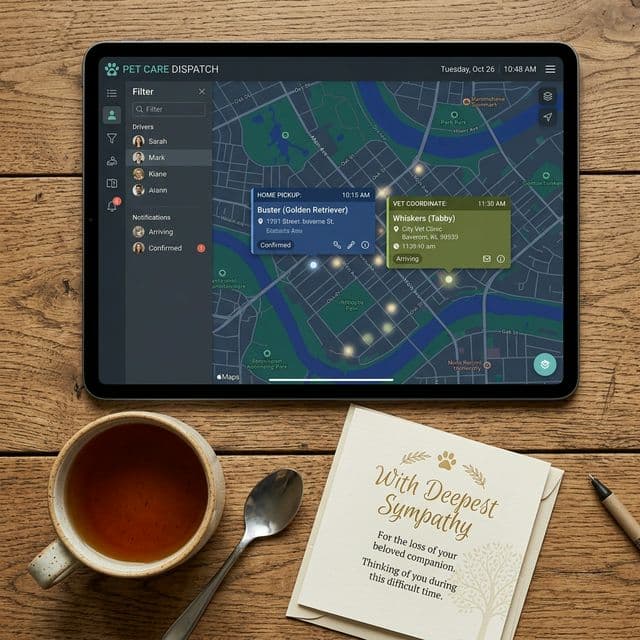
When a grieving family requests a residential pet removal, they expect an immediate response; forcing them to wait three hours because your routing is inefficient is completely unacceptable. Delayed response times exacerbate the family's trauma and frequently cause them to cancel the service entirely in favor of a faster competitor. DispatchNode utilizes predictive AI routing and live GPS integration to instantly deploy the closest available vehicle, guaranteeing hyper-fast response times that secure the booking and build massive trust.
The Critical First Hour
The first hour following a pet's passing is highly chaotic for the family; their primary goal is to have the remains handled with dignity and speed. DispatchNode eliminates the administrative delays inherent in manual dispatching, allowing the crematory to transition from a phone call to a driver en route in a matter of seconds, capitalizing on the critical window of opportunity.
In a manual operation, an emergency residential pickup request disrupts the entire daily plan. The dispatcher must hang up the phone, look at a map, call three different drivers to determine their locations, and try to negotiate a detour. This process frequently takes twenty to thirty minutes before a driver even begins moving toward the family's home. During this time, the family is sitting in agonizing silence.
The AI routing engine executes this calculation in milliseconds. Because the system continuously tracks the GPS location and the remaining payload capacity of the entire fleet, it instantly identifies the optimal asset for the job. It does not select the driver who is closest "as the crow flies"; it selects the driver who can arrive fastest based on live municipal traffic data and their current manifest sequence.
By automating the dispatch decision, the software allows the facility to guarantee rapid response times. When the family calls, the AI agent or the human operator can state with absolute confidence: "We have a technician in your area, and they will be at your door in twenty-two minutes." This immediate, definitive answer completely de-escalates the family's panic and secures their commitment.
Dynamic Rerouting for Active Drivers
Diverting a driver who is already actively executing a scheduled route requires highly intelligent software to prevent the entire manifest from collapsing. DispatchNode smoothly injects emergency residential pickups directly into the driver's mobile application, automatically recalculating the turn-by-turn sequence to minimize the delay to the remaining scheduled veterinary clinic sweeps.
The primary fear of a dispatcher is that diverting a driver to an emergency residential call will cause them to be late for a massive corporate veterinary sweep, angering a high-value client. The AI platform mitigates this risk through algorithmic load balancing.
When the emergency stop is injected, the system analyzes the remaining stops on that driver's manifest. If the detour will cause the driver to violate their scheduled arrival window for a critical veterinary clinic, the system automatically offloads the clinic sweep to a secondary driver who is operating in an adjacent zone. This massive logistical recalculation occurs invisibly in the background.
The driver on the road simply follows the updated instructions on their tablet. The system alerts them: "High Priority Route Change. Proceed to new residential address." This dynamic agility allows the crematory to aggressively capture high-margin emergency residential calls without ever sacrificing the reliability of their recurring corporate veterinary contracts.
The Financial Value of Speed
Speed is the ultimate differentiator in the pet aftercare industry; families are willing to pay significant premium rates for guaranteed rapid response times. DispatchNode empowers the crematory to implement tiered, dynamic pricing models, charging premium fees for immediate "Rush" dispatches while maintaining lower base rates for scheduled next-day pickups, drastically increasing the revenue generated per vehicle.
Many operators leave money on the table by charging a flat removal fee regardless of the urgency. If a family demands a pickup within the hour, they are consuming dedicated, immediate logistical resources and should be charged accordingly. The software makes this pricing strategy effortless to implement and enforce.
During the booking process via the digital portal or the AI voice agent, the client is presented with options. "Standard Removal (within 4 hours) - $150. Immediate Rush Removal (within 45 minutes) - $250." Because the family is in distress, they will frequently select the higher-priced immediate option to expedite the process.
The AI routing engine guarantees that the crematory can actually deliver on the "Rush" promise. By reliably executing rapid response times, the operator converts logistics into a highly profitable upsell. They maximize the revenue generated by every truck on the road, utilizing speed as a premium product rather than just an operational goal.
Reducing Driver Stress and Fatigue
Constantly rushing across town to fulfill impossible manual dispatch orders burns out drivers rapidly, leading to high turnover and decreased service quality at the door. DispatchNode protects the drivers by providing mathematically perfect routes and realistic ETAs, ensuring they arrive at the grieving family's home calm, composed, and capable of delivering profound empathy.
A driver who has just spent an hour stressed out in traffic because their dispatcher gave them an impossible deadline cannot effectively console a grieving family. They arrive agitated, rushed, and unprofessional. The family immediately senses this tension, which destroys the trust the facility is trying to build.
The AI routing engine only assigns routes that are physically possible based on live traffic data. It factors in the necessary "dwell time" at the residence, knowing that the driver needs fifteen minutes to speak with the family, respectfully handle the remains, and complete the digital chain-of-custody scans.
By removing the logistical stress from the driver, the software empowers them to focus entirely on the emotional aspect of the job. They become highly effective ambassadors for the crematory, providing the calm, professional presence that grieving families desperately need. This consistent, high-quality field execution guarantees positive reviews and secures the long-term reputation of the facility.
Response Time Benchmarks by Pickup Type
Response time expectations vary dramatically depending on the nature of the pickup request. An emergency residential call from a family whose pet has just passed requires fundamentally different routing logic than a scheduled veterinary clinic sweep. Understanding these benchmarks is critical for operational planning.
| Pickup Type | Industry Average Response | DispatchNode Target | Revenue Impact of Delay |
|---|---|---|---|
| Emergency Residential (P0) | 90 - 180 minutes | Under 45 minutes | Each 30-min delay = 15% abandonment risk |
| Emergency Vet Clinic (P0) | 60 - 120 minutes | Under 30 minutes | Clinic switches vendors after 2 missed SLAs |
| Scheduled Residential (P2) | 2 - 4 hour window | 1 hour window | Tighter windows = higher client satisfaction |
| Recurring Clinic Sweep (P2) | Half-day window | Exact 30-min ETA | Precision locks in exclusive contracts |
The data reveals a clear pattern: every minute of unnecessary delay erodes both revenue and reputation. A family who waits three hours for a residential pickup will leave a negative review regardless of how empathetic the technician is upon arrival. Speed is not a luxury in pet aftercare; it is the baseline expectation that determines whether a facility thrives or slowly collapses under competitor pressure.
The Emergency Dispatch Algorithm
When a P0 emergency request enters the system, the routing engine executes a fundamentally different algorithm than it uses for standard scheduled work. The goal shifts from fuel optimization to absolute minimum arrival time.
The critical distinction is that the algorithm interrupts the nearest driver's current route, even if that driver is mid-way through a lower-priority manifest. In manual dispatching, a human dispatcher would likely assign the job to the next available driver rather than rerouting an active one, adding 20-40 minutes of unnecessary delay.
Residential Pickup Readiness Protocol
Reducing response time is not solely about driving faster; it is about eliminating every point of operational friction between the family's call and the technician's arrival at their door. The AVMA recommends that aftercare providers communicate clear preparation instructions to families in advance.
- Pre-Arrival Briefing: The AI agent instructs the family on how to prepare the pet for respectful transfer (e.g., placing the pet on a blanket on the floor of a first-floor room).
- Weight Pre-Assessment: The AI asks for the pet's approximate weight during the call to ensure the dispatched driver has the appropriate carrying equipment.
- Parking Logistics: For apartment or condo pickups, the AI asks the family to describe the nearest parking access point to prevent the driver from circling the building.
- Emotional Preparation: The AI gently informs the family that the technician will knock softly and wait patiently at the door, giving them time to say final goodbyes.
- Payment Handling: The system sends a Stripe payment link via SMS before the driver arrives, removing the awkward necessity of discussing money face-to-face during the removal.
By resolving these logistical details during the initial AI conversation, the actual physical pickup is executed in under 10 minutes, minimizing the family's exposure to the operational mechanics of the removal. Read more about optimizing driver workflow in our guide on Route Planning for Pet Crematory Drivers.
Predictive Fleet Staging and Spatial Positioning
Reducing response times for residential pet pickups requires moving beyond reactive dispatching and implementing predictive fleet staging. A reactive operator waits for the phone to ring, and then dispatches a truck from the central facility. In a sprawling metropolitan area, this guarantees response times of an hour or more, subjecting the grieving family to prolonged distress.
Sophisticated operators utilize their dispatch software's historical data to execute predictive staging. The AI algorithm analyzes years of intake data to identify geographic "heat maps" of after-hours demand. For example, the data may reveal a statistically significant concentration of residential euthanasias occurring in a specific affluent suburb between 6:00 PM and 9:00 PM on weekdays.
Instead of keeping all vehicles parked at the central crematory facility during these hours, the dispatch platform automatically instructs an on-call driver to proactively position their vehicle at a staging point—such as a specific commercial parking lot—directly in the center of that suburban heat map.
When the inevitable phone call comes in from that zip code, the vehicle is already positioned just five minutes away. The AI voice agent can confidently tell the grieving family, "We have a dedicated care specialist right in your area, and they will be at your door in under ten minutes." This hyper-fast response time completely eliminates the agonizing waiting period for the family, transforming a potentially traumatic logistical delay into an experience of immediate, profound support, and generating fierce brand loyalty.
Algorithmic Triage for Veterinary Overflows
While residential pickups require immediate emotional response, veterinary clinic sweeps require rapid volumetric response. A high-volume emergency veterinary hospital can rapidly accumulate hundreds of pounds of communal remains over a busy weekend. If the crematory cannot provide a rapid pickup, the hospital's cold storage facilities will overflow, creating a severe biohazard crisis and forcing the hospital to halt intake procedures.
If a crematory fails to respond rapidly to these overflow events, the hospital will immediately seek a more reliable vendor. To prevent this, advanced dispatch software employs algorithmic triage specifically designed for veterinary overflow.
When an emergency hospital logs an overflow request via their secure portal, the system does not simply add it to the next day's route. The algorithm instantly categorizes the request as a "Critical Volumetric Escalation." It scans the live GPS locations and current payload capacities of the entire active fleet.
If it identifies a driver who is currently executing a low-priority residential return route (delivering urns) twenty miles away, but who has a completely empty biohazard compartment, the algorithm executes an immediate dynamic reroute. It pauses the urn deliveries, pushes the emergency hospital stop to the top of the driver's manifest, and routes them via the fastest possible highway vector. By prioritizing critical volumetric constraints over standard sequential routing, the operator protects their most valuable commercial clients from operational shutdowns, cementing their status as an indispensable logistical partner.