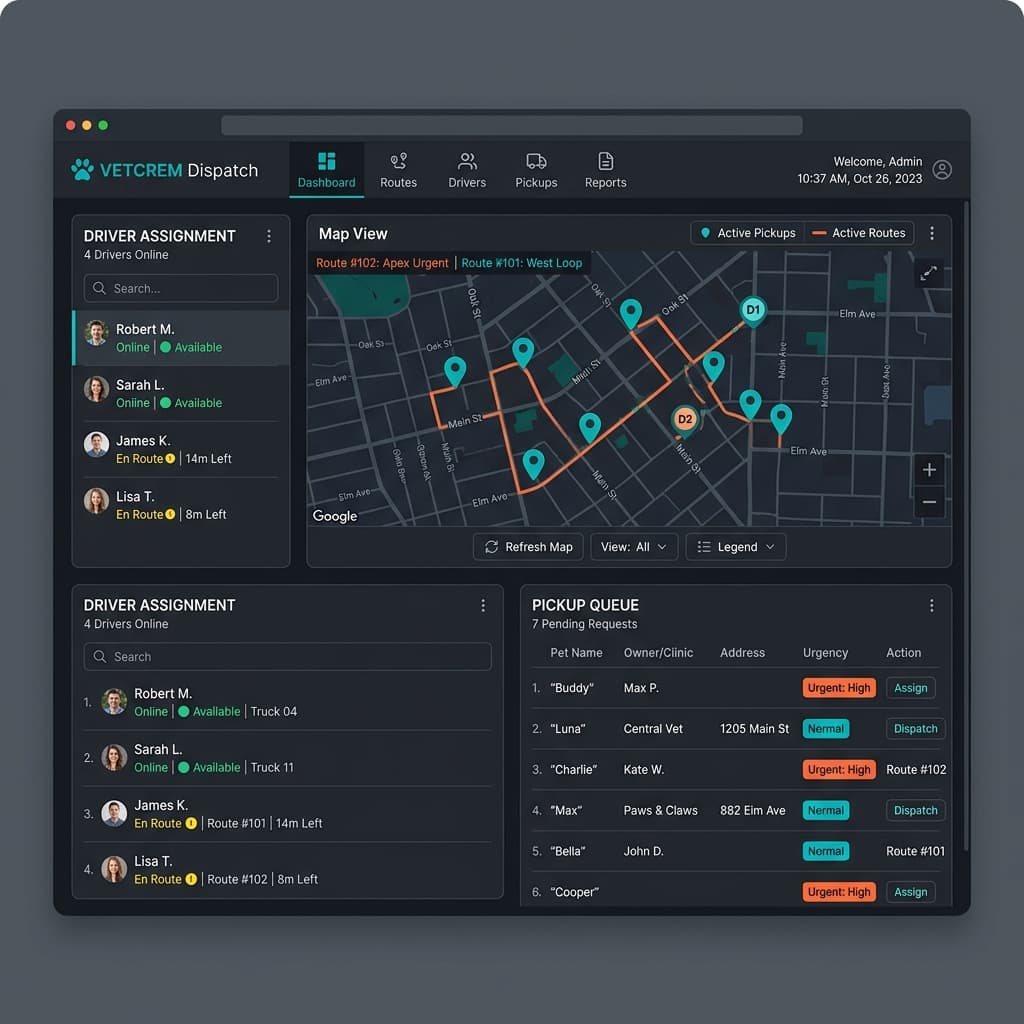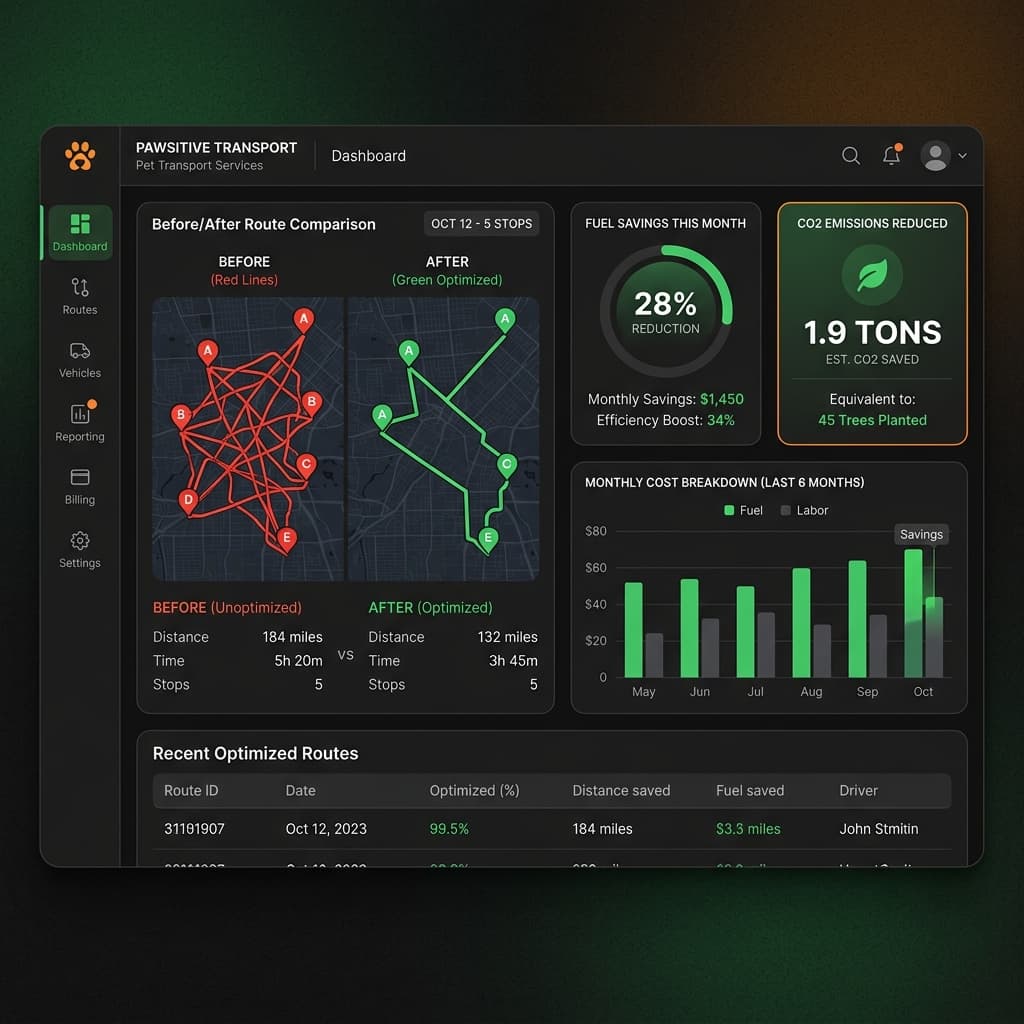
Relying on a dispatcher's intuition to route multiple pet transport vehicles guarantees massive diesel waste and destroyed profit margins. When drivers zig-zag across the city performing randomly assigned veterinary sweeps and residential pickups, they spend more time in traffic than actively servicing clients. DispatchNode deploys a mathematically rigorous AI routing engine that clusters jobs by strict geographic zones, ensuring your vehicles operate at absolute maximum efficiency and guaranteeing rapid response times.
The Physics of Crematory Routing
Routing a pet transport vehicle requires calculating variables that standard mapping applications completely ignore, such as fluctuating payload capacity and strict arrival windows at corporate veterinary clinics. DispatchNode analyzes the precise spatial capacity of every assigned vehicle and builds routes that maximize payload without forcing the driver to arrive late for high-priority veterinary sweeps.
Standard GPS routing assumes a delivery vehicle making drops; a crematory vehicle is making continuous pickups, meaning the payload weight and required interior volume are constantly increasing throughout the shift. If a dispatcher fails to account for this, the driver will arrive at their final scheduled veterinary clinic only to realize their van is physically full, resulting in a disastrous failure to service the account.
The AI routing platform eliminates this inefficiency by tracking the cumulative volume of every scheduled stop. When building the daily manifest, it perfectly sequences the stops. It ensures that the massive, high-volume veterinary clinics are serviced when the vehicle is entirely empty, while smaller residential pickups are smoothly woven into the return leg of the journey.
Furthermore, the system strictly enforces geographic service zones. It refuses to allow a dispatcher to schedule a single residential removal on the far side of the city unless a massive premium fee is attached to the work order. By maintaining strict zone discipline, the operator guarantees that every mile driven is generating maximum revenue and minimizing unnecessary fuel burn.
Dynamic Recalibration During the Shift
A perfectly planned route shatters the moment a driver encounters gridlock traffic or is dispatched to an emergency residential removal. DispatchNode provides an elastic routing matrix that dynamically recalibrates the entire daily manifest in real-time based on live traffic data and emergency injections, guaranteeing the driver completes the maximum number of stops safely before their shift expires.
When a massive accident shuts down an interstate, a driver relying on a paper route sheet is paralyzed. They are stuck in traffic, bleeding expensive hourly labor, while the veterinary clinics scheduled for the remainder of the day are left unserviced. The dispatcher in the office is completely blind to the severity of the delay until the furious clinic managers start calling.
The AI platform constantly monitors the live GPS position of the vehicle against real-time municipal traffic APIs. If the software detects a severe delay on the projected path, it instantly calculates a detour. If the delay makes it impossible for the driver to complete the final stops on their manifest within the scheduled arrival windows, the system automatically offloads those specific jobs to another vehicle operating in an adjacent, unaffected zone.
This dynamic load-balancing happens autonomously in the background. The drivers simply follow the updated turn-by-turn navigation on their mobile tablets. The system also automatically transmits SMS updates to the affected veterinary clinics, adjusting their expected service window and maintaining total transparency without requiring the dispatcher to make dozens of frantic phone calls.
Predictive Clinic Sweeps
Route density is the key to profitability, and it can only be achieved through predictive, highly localized sweep scheduling. DispatchNode analyzes the historical removal volumes of all partner veterinary clinics in a specific geographic cluster, automatically aligning their sweep schedules to trigger simultaneously, creating hyper-dense, massively profitable routing days.
If an operator has ten veterinary clinics located in a single metropolitan sector, servicing them on ten different days throughout the month destroys the profit margin of those contracts. The AI engine recognizes the geographic proximity of these assets. Even if their volume fluctuates slightly, the software calculates the optimal median date to perform a massive, consolidated sweep of all ten clinics simultaneously.
The system automatically generates a proposal to the clinic managers: "We are establishing a dedicated sweep day for your sector every Tuesday and Friday morning. By aligning your schedule, we can guarantee rapid turnaround times for your clients' private cremations." The clinics appreciate the predictability, and the crematory secures a route density that is practically unbeatable by competitors.
This predictive clustering transforms route planning from a daily struggle into a long-term strategic advantage. The operator can authorize the purchase of a new transport van and immediately assign it a mathematically perfect, fully loaded route that generates positive cash flow from day one, rather than slowly building route density over months of inefficient, scattered service calls.
Measuring Profit Per Mile
Operators relying on manual routing intuition have no idea which routes are actually generating profit and which are operating at a loss. DispatchNode provides a comprehensive financial dashboard that calculates the exact profit per mile driven for every single route, exposing severe operational inefficiencies and empowering the owner to make data-driven pricing adjustments.
The dashboard correlates the total revenue generated by the daily manifest against the specific costs of execution: fuel consumed, hourly labor paid to the driver, and vehicle wear-and-tear. It reveals the harsh truth about legacy routing habits. A sweep route that the dispatcher considered "busy" might actually be losing money because it requires excessive cross-town driving for low-volume clinics.
Armed with this precise data, the business owner can execute surgical adjustments to their pricing model. If a specific geographic zone consistently yields a negative profit-per-mile, the operator has two choices: increase the route density by aggressively marketing to other clinics in that specific area, or instantly raise the base removal rate for all clients in that zone to offset the logistical costs.
By treating the transport fleet as a highly sophisticated logistics network rather than a collection of glorified delivery vans, crematories utilizing AI routing platforms achieve massive financial superiority. They cut their fuel expenditures, maximize their labor utilization, and ensure that every single removal contributes directly to the bottom line.
Daily Route Structure for Pet Crematory Drivers
An optimally structured daily route balances three competing priorities: fixed clinic sweep windows, unpredictable residential requests, and cold-chain time limits. The routing engine must sequence these stop types intelligently.
| Time Block | Route Activity | Priority Level | Flexibility |
|---|---|---|---|
| 6:00 AM - 8:00 AM | Overnight emergency residential pickups | P0 (Completed) | Fixed (already executed) |
| 8:00 AM - 11:00 AM | Morning veterinary clinic sweeps | P2 (Scheduled) | Low (contracted windows) |
| 11:00 AM - 1:00 PM | Ad-hoc residential pickups | P1 (Urgent) | High (inserted dynamically) |
| 1:00 PM - 3:00 PM | Afternoon clinic sweeps + overflow | P2 | Moderate |
| 3:00 PM - 5:00 PM | Return to facility + intake processing | N/A | Fixed |
The engine builds the morning route around the anchor points of clinic sweep windows, then dynamically inserts residential pickups into geographically logical positions as they arrive throughout the day. This hybrid approach prevents the two common failure modes: over-committing to fixed schedules (which causes residential delays) or over-prioritizing ad-hoc work (which causes missed clinic windows).
Route Density Optimization
The single most important metric for crematory fleet profitability is route density: the number of pickups executed per mile driven. Higher density means lower fuel costs, less vehicle wear, and faster service times.
The algorithm groups geographically proximate stops into clusters and assigns each cluster to the nearest vehicle. This prevents the devastating inefficiency of a single driver zig-zagging across the entire city. In practice, cluster-based routing reduces total fleet mileage by 25-35% compared to first-come-first-served dispatch.
Driver Efficiency Benchmarks
Tracking individual driver performance is essential for identifying training needs and rewarding top performers. The Department of Transportation publishes fleet efficiency guidelines that provide useful baselines for commercial vehicle operations.
- Stops Per Shift: The target is 8-12 stops per 8-hour shift. Drivers consistently below 6 stops require route optimization or retraining.
- Average Dwell Time: Track how long each driver spends at each stop. Residential pickups should average 15-20 minutes; clinic sweeps with 3+ pets should average 10-15 minutes.
- Fuel Efficiency: Monitor miles-per-gallon at the individual vehicle level to detect mechanical issues or aggressive driving habits.
- On-Time Rate: Measure the percentage of stops completed within the projected arrival window. The target is 95%+ for clinic sweeps.
- Scan Compliance: Track the percentage of pickups where the driver successfully scanned the barcode at the point of transfer. The target is 100% with zero exceptions.
Drivers who consistently exceed benchmarks should be rewarded with premium routes and first-choice shift selections. For a broader view of fleet performance, read our guide on Fleet Management for Pet Cremation Services.
Spatial Sequencing and Biohazard Segregation
The routing logic for a pet crematory fleet must prioritize variables that generic logistics software completely ignores. A standard delivery route for packages is optimized entirely for speed and minimum mileage. However, a crematory driver frequently handles both the intake of deceased pets (biohazard) and the delivery of finished memorial urns (high-value fragile items) within the same shift. Attempting to optimize this mixed manifest purely for speed creates catastrophic operational risk and violates the core principles of dignified care.
Advanced dispatch routing engines employ "Spatial Sequencing and Biohazard Segregation." The software understands the strict physical constraints of the vehicle's cargo architecture. If a vehicle is equipped with a clean forward compartment for urns and a sealed rear compartment for biohazard intake, the algorithm will mathematically enforce a specific sequence of stops.
The software will always attempt to front-load the route with urn deliveries. By sequencing the route so that the driver executes all memorial returns to veterinary clinics before ever opening the biohazard intake doors, the operator absolutely guarantees that finished urns are never exposed to the cross-contamination risk or the olfactory environment of a heavily loaded biohazard sweep. This strict sequencing might add ten percent more mileage to the daily route compared to a purely geographic optimization, but it acts as a structural insurance policy against a devastating breakdown in chain-of-custody integrity, ensuring veterinary clinics receive their urns in pristine condition.
Mitigating Driver Burnout through Algorithmic Pacing
The emotional toll of driving a pet removal route is staggering. A driver is not dropping off cardboard boxes; they are entering the homes of devastated families, acting as amateur grief counselors, and physically handling deceased companions. This intense emotional labor rapidly accelerates psychological burnout. If an operator utilizes routing software that treats drivers like autonomous drones—packing their schedule with twelve back-to-back residential pickups with zero downtime—the driver will inevitably crack, leading to massive turnover and potential vehicular accidents.
Modern routing algorithms incorporate "Algorithmic Pacing" to actively mitigate this driver burnout. The software is programmed to recognize the emotional weight of different types of stops. A veterinary sweep for communal remains is physically demanding but emotionally low-impact. A residential pickup for an unexpected euthanasia is emotionally devastating.
The dispatch algorithm dynamically balances the driver's manifest. If the software assigns a driver to a particularly traumatic residential pickup, it will automatically inject a predefined "Recovery Buffer" into the schedule before their next stop. The software will not route them immediately to another grieving family; instead, it might route them to an automated car wash for a necessary cleaning, or simply provide a fifteen-minute spatial buffer, allowing the driver to decompress and regain their emotional equilibrium. By algorithmically managing the psychological load of the route, the operator protects their most valuable human assets, dramatically increasing retention and ensuring that the final family of the day receives the exact same compassionate care as the first.
The algorithmic pacing of the route also provides invaluable data for long-term human resources strategy. The software tracks the "Emotional Load Index" of every driver over time. If the system detects a specific driver has been assigned a disproportionately high number of traumatic residential removals over a thirty-day period, it automatically flags the HR manager. This allows the operator to proactively intervene, rotating the driver to a purely commercial route to prevent catastrophic burnout and maintain a healthy, stable workforce.