Hiring a generic answering service to manage grieving families at 2:00 AM is a catastrophic operational decision. Call center employees reading from a script cannot provide the deep empathy required, nor can they accurately capture the complex logistical data needed to execute a private cremation removal. PetPickupNow replaces apathetic call centers with a highly specialized AI voice agent that delivers reliable grief support while instantly executing complex dispatch routing.
The Absence of Empathy in Call Centers
The death care industry requires absolute emotional tact; a generic operator handling pizza delivery complaints in one breath and a pet loss call in the next cannot project genuine empathy. PetPickupNow deploys AI voice agents specifically trained on grief counseling protocols, ensuring every midnight caller receives a consistently compassionate response that instantly establishes trust.
When a family calls a crematory after the sudden passing of their pet, they are in a state of shock. They need immediate validation of their grief. A generic answering service agent is financially incentivized to keep the call as short as possible to minimize per-minute billing. They will rapidly ask for the weight of the animal and the address, completely ignoring the emotional state of the caller. This feels incredibly cold and transactional to the family.
The AI voice agent never breaks character. It utilizes advanced natural language processing to detect distress and adjusts its pacing and tone accordingly. It always begins by validating the loss: "I am so deeply sorry to hear about the passing of your pet. Please take your time." This consistent, high-level emotional intelligence is impossible to replicate across a staff of outsourced human operators.
By providing genuine comfort during the initial interaction, the AI secures the booking. The family feels respected and cared for, ensuring they will entrust their beloved pet's remains to the facility rather than hanging up and calling a competitor.
The Inability to Route or Quote
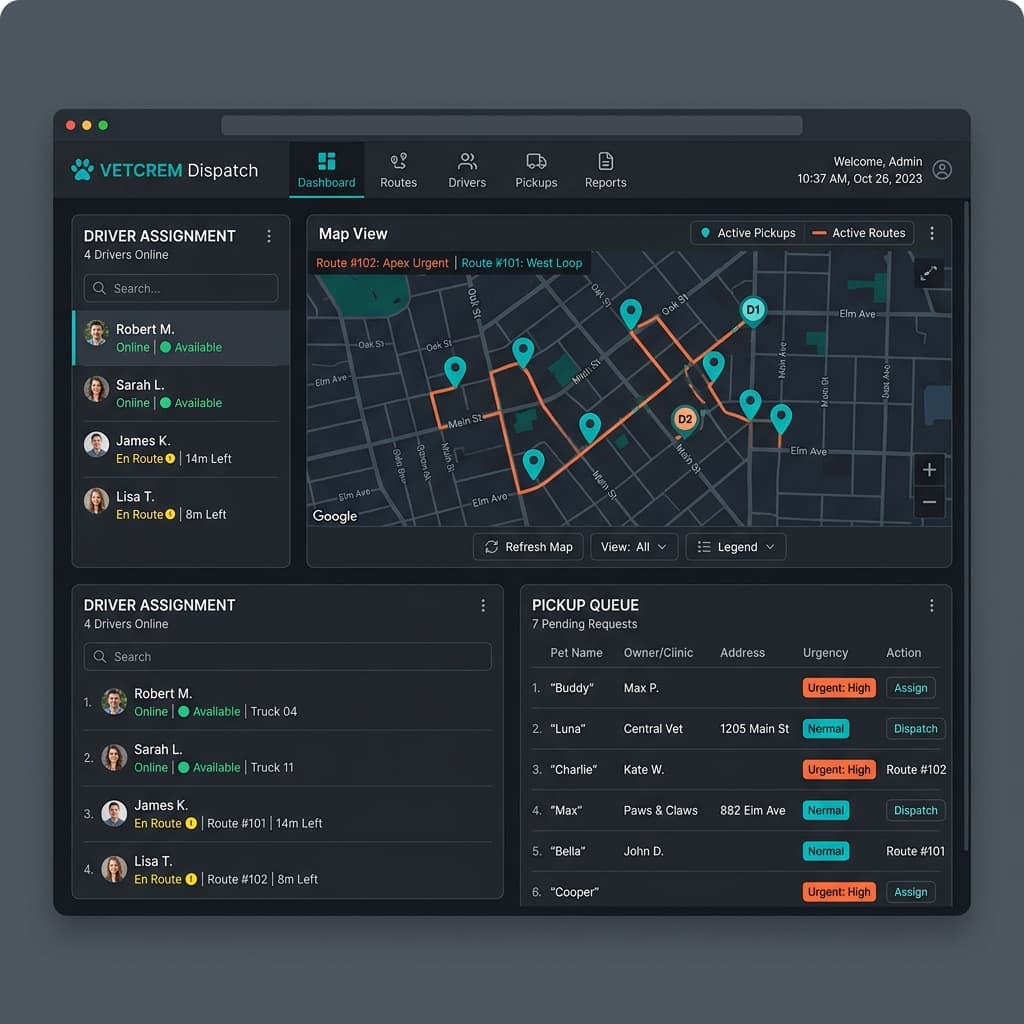
Generic answering services are strictly message-takers; they cannot quote dynamic emergency pricing or automatically dispatch a transport vehicle. PetPickupNow empowers its AI agent to instantly calculate removal rates based on the caller's address, quote after-hours premiums, and inject the confirmed work order directly into the closest driver's mobile app, completely bypassing the human dispatcher.
A family requesting an immediate residential pickup wants an ETA and a price, not a promise that "someone will call you back in the morning." The generic answering service creates a massive bottleneck. The operator must transcribe the message, email it to the facility manager, who must then wake up, calculate the rate, and call the family back.
The AI agent executes the entire transaction instantly. It verifies the address against live GPS data to determine the distance from the facility. "We have a technician in your area. The after-hours removal fee for a private cremation is three hundred and fifty dollars. Shall I secure your booking and dispatch the vehicle?"
Once the client authorizes the service, the system acts autonomously. It pings the on-call driver's tablet, overrides silent mode, and provides turn-by-turn navigation. The business owner wakes up the next morning to find the revenue secured and the pet safely logged into the cold storage facility, with zero administrative friction.
Handling Complex Veterinary Inquiries
Veterinary clinics frequently make after-hours calls to request emergency sweeps when their cold storage is full. A generic receptionist cannot verify contract details or navigate complex corporate veterinary accounts. PetPickupNow allows the AI agent to instantly cross-reference the incoming phone number with the active client database, recognizing the clinic and executing the sweep according to their specific contractual terms.
When the night manager at a 24/7 emergency veterinary hospital calls to request a pickup, they expect the vendor to know exactly who they are. If a generic answering service agent asks them to spell the name of the clinic and provide an account number, the veterinary manager becomes incredibly frustrated.
The AI agent provides a frictionless experience. It answers the call: "Hello, Main Street Emergency Vet. I see you are calling outside your scheduled sweep window. Do you need an emergency pickup tonight?" This immediate recognition demonstrates extreme professionalism and technical capability.
The AI then generates the emergency work order, ensuring that the specific billing codes and chain-of-custody requirements for that corporate account are perfectly attached to the dispatch alert. This reliable execution secures the highly lucrative emergency clinic contract.
The Economics of AI Scalability
Traditional answering services charge exorbitant per-minute rates and frequently place callers on hold when volume spikes. PetPickupNow provides a flat-rate, infinitely scalable AI architecture that handles unlimited concurrent calls simultaneously, drastically reducing telecommunications overhead while guaranteeing zero grieving families are ever placed on hold.
During a severe weather event, a crematory might receive dozens of calls simultaneously. A traditional call center will collapse, leaving families listening to elevator music while holding their deceased pets. This is an unforgivable failure in the aftercare industry.
The AI absorbs the volume effortlessly. Whether handling one call or one hundred calls, the system delivers the exact same empathetic, technically perfect response. By replacing highly expensive, fundamentally flawed human receptionists with specialized AI technology, pet crematories secure every inbound lead and establish absolute operational dominance in their market.
Feature Gap Analysis: Answering Services vs. PetPickupNow
The structural differences between a generic answering service and a purpose-built aftercare AI platform extend far beyond tone of voice. The entire operational capability set is fundamentally different.
| Capability | Generic Answering Service | PetPickupNow AI |
|---|---|---|
| Grief-Specific Training | None (shared operator pool) | Deep corpus: pet loss empathy framework |
| Dispatch Integration | None (takes a message) | Direct GPS routing to nearest driver |
| Payment Collection | None | Automated Stripe SMS link |
| Chain-of-Custody Init | None | Generates barcoded tracking tag at intake |
| Concurrent Call Handling | Limited (3-5 operators on shift) | Infinite (independent AI instances) |
| Pricing Knowledge | None (defers all questions) | Full knowledge of services, urns, timelines |
The answering service model was designed for HVAC companies and plumbing emergencies where the caller simply needs to leave a name and phone number. Pet aftercare requires a completely different interaction model where the AI must simultaneously provide emotional support, gather logistical data, and execute a dispatch workflow. These are fundamentally incompatible use cases.
Cost Structure: Per-Minute Billing vs. Flat-Rate AI
Generic answering services charge between $0.95 and $2.50 per minute of operator time. A typical pet loss call lasts 8-15 minutes because the caller is emotional and needs time to process. This creates a perverse financial incentive for the operator to rush the grieving family off the phone.
With PetPickupNow, there is zero marginal cost per call. The AI can spend 30 minutes with a sobbing caller without generating a per-minute invoice. This structural difference in cost architecture directly translates to a structural difference in care quality. The AVMA consistently emphasizes that unhurried, compassionate communication is the foundation of ethical aftercare.
How the AI Achieves Genuine Empathy
Skeptics often question whether an AI can genuinely provide empathetic support during a pet loss call. The answer lies in the specificity of the training corpus and the deliberate pacing architecture of the voice model.
- Grief Lexicon Training: The AI is trained on thousands of real pet loss conversations, learning to recognize distress signals like prolonged silence, crying, and fragmented speech.
- Pacing Control: Unlike human operators who speak at a natural conversational speed, the AI is programmed to speak 20% slower during the first 90 seconds of a call, matching the caller's emotional state.
- Validation Prioritization: The AI always validates the loss before asking any logistical questions: "I am so deeply sorry. [Pet's name] was clearly deeply loved."
- Question Sequencing: Logistical questions (address, weight, service type) are introduced gradually, never in a rapid-fire checklist format.
- Silence Tolerance: The AI is trained to tolerate up to 15 seconds of silence without speaking, giving the caller space to compose themselves.
This level of conversational design is impossible to replicate across a pool of minimum-wage call center operators working overnight shifts. Read our detailed exploration in AI Voice Agents for After-Hours Pet Services.
The Liability of Empathy-Driven Misinformation
When evaluating the risk of utilizing generic answering services in the pet aftercare sector, operators frequently focus entirely on the lack of compassion. However, the far more dangerous threat to the business is the liability generated by well-intentioned but fundamentally inaccurate information provided by untrained receptionists.
When a grieving family asks a generic answering service a specific logistical question—such as, "Will my dog be cremated alone?" or "How long does the aquamation process take?"—the receptionist, eager to provide comfort, will often guess the answer or provide a generalized, inaccurate response.
If a receptionist incorrectly assures a caller that their pet will be cremated privately when the family actually authorized (and paid for) a communal cremation, the operator is instantly exposed to a massive legal and public relations liability. The family expects an urn return; the crematory processes the communal batch. When the family calls a week later asking for the ashes, the discrepancy is discovered, leading to profound emotional trauma for the family and devastating reputational damage to the operator.
An AI voice agent built on a domain-specific Large Language Model entirely mitigates this liability. The AI is structurally incapable of guessing. It only provides answers that are explicitly verified within its highly controlled knowledge base. If a family asks a complex technical question regarding the temperature curves of the retort, the AI provides the exact, operator-approved response. If the question falls outside of its approved parameters, the AI executes a seamless handoff: "That is a very important question regarding the memorialization process. I want to make sure you have the exact details. Please hold for one moment while I connect you with our facility director." This strict adherence to verified information protects the operator from the devastating consequences of empathetic misinformation.
The Financial Drain of the Callback Queue
The operational reality of utilizing an answering service is that it merely shifts the burden of work; it does not eliminate it. A generic answering service operates entirely on a "message-taking" protocol. When a grieving family calls at 2:00 AM, the answering service collects their basic information and places the message in a queue for the crematory staff to address when the office opens at 8:00 AM.
This creates a massive, crushing callback queue for the morning staff. Instead of focusing on dispatching morning routes and managing facility operations, the staff must spend the first two hours of their shift calling back a dozen grieving families. Furthermore, this delay drastically reduces the conversion rate. In the six hours between the initial call and the callback, the frantic family has likely researched other local crematories and may have already booked a removal with a more responsive competitor.
The financial drain of the callback queue is twofold: the operator pays the answering service to take the message, and then pays their internal staff their hourly wage to perform the actual triage and booking that should have happened during the initial call.
An AI dispatch agent completely destroys the callback queue. Because the AI is integrated directly with the operator's CRM and routing software, it executes full-cycle transaction resolution. When the family calls at 2:00 AM, the AI secures the address, determines the cremation type, calculates the invoice, texts a secure payment link, and automatically schedules the pickup on the driver's manifest. When the human staff arrives at 8:00 AM, there are no voicemails to return; there is only a list of fully booked, fully paid service orders ready for immediate execution. This allows the operator to reallocate their human staff to high-value tasks, significantly reducing administrative payroll while drastically increasing the after-hours conversion rate.
The elimination of the callback queue fundamentally alters the work-life balance of the facility owner. In standard operations, the owner frequently wakes up at 5:00 AM dreading the chaotic scramble to process the overnight voicemails before the morning routes depart. With an AI dispatch platform, the owner wakes up to a fully optimized, financially settled operational dashboard. This transition from reactive crisis management to proactive strategic oversight allows the owner to focus entirely on B2B relationship building and long-term enterprise growth.