Purchasing an additional fifty-thousand-dollar cremation retort will not scale your business if your dispatchers are completely overwhelmed and your drivers are constantly lost. Throwing physical assets at a logistical problem only accelerates the chaos. DispatchNode provides the AI-native software infrastructure required to scale your crematory infinitely, automating complex routing, enforcing digital chain of custody, and handling unlimited call volume without requiring you to hire an army of expensive back-office staff.
The Bottleneck of Manual Dispatching
The growth of a manual crematory operation is strictly capped by the cognitive limit of the dispatcher. Once a facility exceeds twenty daily pickups spread across multiple veterinary clinics and residential addresses, a single human dispatcher relying on a whiteboard will inevitably make catastrophic routing errors. DispatchNode removes this bottleneck entirely by replacing human intuition with mathematically perfect, AI-driven routing algorithms.
When a crematory attempts to scale by simply hiring more drivers and signing more veterinary clinics without upgrading their dispatch software, they experience a massive drop in service quality. Drivers cross paths, massive corporate clinics are skipped, and grieving families are left waiting for hours. The dispatcher spends their entire shift answering frantic phone calls from lost drivers and angry clinic managers, completely unable to manage the operation proactively.
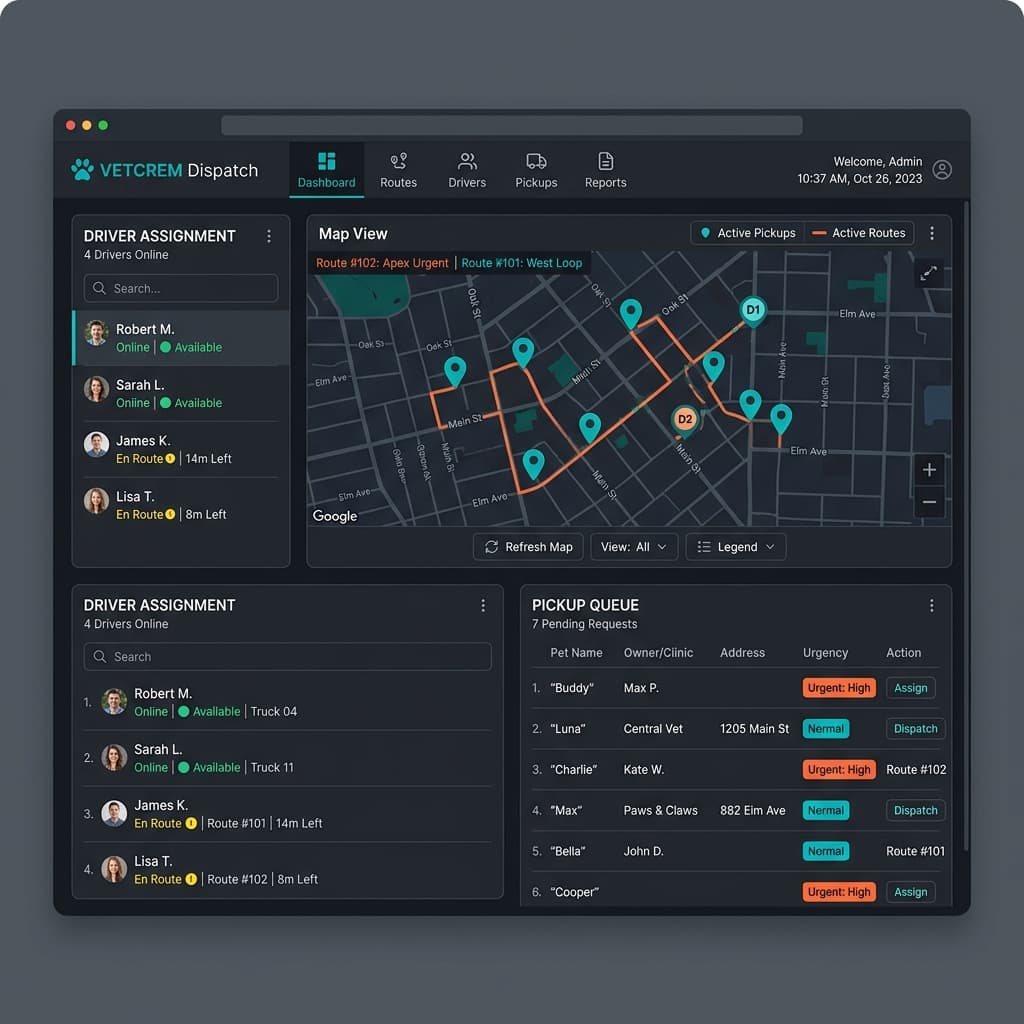
The AI routing platform thrives on complexity. It can instantly analyze the live GPS coordinates of twenty transport vehicles, calculate the fluctuating payload capacities of each van, and inject fifty new emergency pickups into the daily manifest without breaking a sweat. The algorithm requires the exact same amount of time to route five trucks as it does to route fifty.
This algorithmic scalability fundamentally alters the economics of the business. The owner can aggressively pursue new, massive veterinary contracts knowing that their dispatch infrastructure will effortlessly absorb the increased volume. The single dispatcher transitions from a frantic route planner into a high-level fleet manager, overseeing a massive operation with complete serenity.
Scaling Customer Service with AI
As pickup volume increases, the volume of inbound phone calls from grieving families and veterinary partners spikes exponentially. DispatchNode prevents your phone lines from becoming a massive bottleneck by deploying infinitely expandable AI voice agents that handle every inbound call instantly, providing profound empathy and flawlessly executing removal logistics.
If a crematory scales its field operations but neglects its phone system, the business will collapse. Placing a grieving pet owner on hold because the human receptionist is overwhelmed with veterinary dispatch calls is an unforgivable failure in the aftercare industry. The family will simply hang up and call the next facility on Google.
The AI voice agent ensures that zero calls are missed, regardless of the volume. If twenty families call simultaneously following a massive regional weather event, the system spins up twenty independent AI instances. Every caller is greeted instantly with profound empathy, and every removal request is instantly converted into a fully routed dispatch order.
This absolute scalability allows the crematory to drastically reduce their administrative overhead. They do not need to hire a massive team of human receptionists or pay exorbitant fees to generic answering services to handle the growth. The AI infrastructure handles the scaling automatically, ensuring maximum profitability as the business expands.
Enforcing Standards at Scale
Scaling an operation frequently results in a degradation of service quality; new, inexperienced drivers are hired quickly and lack the rigorous training of the founding team. DispatchNode prevents this degradation by enforcing strict, step-by-step digital checklists on the driver's mobile app, ensuring every single pickup is executed flawlessly and every barcode is scanned, regardless of the technician's experience level.
A massive liability for a growing crematory is the "pump and run" mentality. If a rushed driver skips the barcode scanning protocol at a veterinary clinic, the entire chain of custody is compromised. In a manual operation, management is completely blind to this failure until the remains arrive at the intake dock completely unidentified.
The mobile app forces compliance. The driver physically cannot close the work order until they have scanned the serialized barcode tag and completed the digital chain-of-custody checklist. This algorithmic discipline ensures that the crematory's strict operational standards are maintained across the entire fleet, whether they are operating five trucks or fifty.
By utilizing software to enforce quality control, the business owner can confidently scale their workforce. They know that every new hire is legally and digitally bound to follow the exact same reliable process as the senior technicians, protecting the brand's reputation as the facility expands into new territories.
The Digital Veterinary Portal
Securing exclusive contracts with massive corporate veterinary groups is the key to explosive scaling, but these groups demand centralized, frictionless digital reporting. DispatchNode provides the professional-tier veterinary portals required to win these bids, allowing corporate directors to instantly access unified billing and reliable compliance manifests for all their locations.
When a crematory attempts to pitch a twenty-location veterinary franchise using paper invoices and faxed cremation certificates, they are immediately disqualified. The corporate accounting department will refuse to work with a vendor that creates massive administrative friction.
The DispatchNode portal is the ultimate sales tool for scaling. The crematory owner demonstrates the software to the corporate director, showing them how all twenty locations are aggregated into a single, clean dashboard. They demonstrate the one-click billing process and the instant retrieval of digital chain-of-custody records.
This professional-tier software infrastructure proves that the independent crematory is capable of handling massive volume professionally. It completely levels the playing field against massive national franchises, allowing the agile local operator to secure the most lucrative commercial contracts in their market and achieve unprecedented scale.
Facility Expansion Triggers
Knowing when to expand from a single crematory to a multi-location operation is a data-driven decision, not an emotional one. The software tracks the operational metrics that signal when a facility is approaching capacity constraints.
| Expansion Trigger | Threshold | Signal Meaning |
|---|---|---|
| Retort Utilization | > 85% daily average | Cannot absorb emergency volume spikes |
| Average Wait Time | > 60 minutes (residential) | Families are experiencing unacceptable delays |
| Cold Storage Occupancy | > 90% average | Risk of turning away clinic sweep volume |
| Driver Overtime | > 15% of total labor hours | Routes are exceeding shift capacity |
| Declined Requests | > 3 per week | Revenue is being lost to geographic limitations |
When three or more of these triggers fire simultaneously for 30 consecutive days, the data is unambiguous: the facility must either add capacity at the existing location (additional retorts) or open a satellite facility in the underserved zone. Expanding without data is reckless; expanding with data is strategic.
Multi-Location Management Architecture
Operating two or more crematory facilities requires a centralized management layer that can allocate fleet resources across locations in real time. The software must treat the entire operation as a single logistics network.
The algorithm considers both geographic proximity and facility capacity when assigning new work. If Location A is closer but its retorts are fully booked for the day, the engine routes the pickup to Location B and adjusts the driver manifest accordingly. This cross-location intelligence prevents bottlenecks and maximizes the throughput of the entire network.
Capital Investment Planning for Growth
Scaling a pet cremation business requires substantial capital investment in vehicles, retorts, and real estate. The SBA (Small Business Administration) provides loan programs specifically designed for small service businesses expanding into new territories.
- Vehicle Acquisition Timing: Purchase new transport vehicles only when the fleet utilization data shows that existing vehicles are operating above 80% capacity for 60+ consecutive days.
- Retort Selection: Choose retort models based on the actual pet size distribution in your territory. If 70% of your cremations are under 50 lbs, invest in small-animal retorts with faster cycle times rather than oversized units.
- Facility Location: Analyze the geographic distribution of your pickup requests to identify the optimal location for a satellite facility. Place it where the highest density of underserved requests originate.
- Staffing Model: Hire intake staff before drivers. A facility bottleneck at the intake dock is more damaging than a slightly longer response time.
- Technology Budget: Allocate 3-5% of gross revenue to technology infrastructure. The dispatch platform, GPS tracking, and AI voice agents are not optional costs; they are the foundation of expandable operations.
For a deeper analysis of fleet economics, read our guide on Fleet Management for Pet Cremation Services.
Hyper-Local Facility Replication vs. Mega-Facilities
When a pet crematory operation achieves regional dominance, the operator faces a critical decision regarding geographic scaling: do they build a massive, centralized "Mega-Facility" and expand their driving radius, or do they utilize "Hyper-Local Facility Replication"?
The Mega-Facility approach seems economically efficient on a spreadsheet, maximizing retort utilization under one roof. However, it completely destroys the logistics of the business. If a truck must drive two hours from the Mega-Facility to reach the edge of the expanded service territory, the mobilization costs skyrocket, and response times for emergency residential pickups become unacceptably slow, completely forfeiting the lucrative "Emotional Premium" of rapid response.
The most successful operators scale through Hyper-Local Facility Replication, a strategy entirely dependent on cloud-based dispatch architecture. Instead of one massive plant, the operator opens smaller satellite facilities equipped with one or two retorts strategically positioned within dense geographic heat maps of demand.
Because the entire enterprise is governed by a unified dispatch platform, these satellite facilities operate as a single, massive logistical organism. The AI voice agent answers all calls centrally but routes the specific removal manifests to the drivers stationed at the appropriate hyper-local satellite. If Satellite A experiences an unexpected retort failure, the software instantly detects the bottleneck and automatically reroutes the active intake manifests to Satellite B, seamlessly balancing the load across the distributed network. This cloud-based replication allows the operator to infinitely expand their geographic footprint while maintaining the hyper-fast, ten-minute response times that guarantee local market dominance.
Algorithmic Franchise Acquisition and Onboarding
As an independent operator scales, the fastest path to massive growth is the acquisition of smaller, struggling competitors. The pet aftercare industry is highly fragmented, filled with "mom-and-pop" operators who have excellent local reputations but lack the technological infrastructure to survive the modern digital marketplace.
The primary friction point in any acquisition is the integration of the acquired company's operations into the parent company's workflow. If the acquired company relies on paper manifests and whiteboards, integrating their historical data and retraining their staff is a logistical nightmare that frequently destroys the value of the acquisition.
Advanced dispatch software functions as an algorithmic "M&A (Mergers and Acquisitions) Engine." When the independent operator acquires a smaller competitor, they immediately deploy their software platform into the new facility. The software’s intuitive, mobile-first design requires almost zero training for the newly acquired drivers.
More importantly, the software standardizes the operational output of the acquired facility overnight. The parent company's rigid Standard Operating Procedures (SOPs)—regarding chain of custody scanning, pricing matrices, and environmental compliance thresholds—are hardcoded into the dispatch workflow. The newly acquired technicians physically cannot execute a pump-out or a retort cycle without satisfying the parent company's digital checks. This absolute technological enforcement allows the parent company to aggressively acquire competitors, instantly inject enterprise-level efficiency into the new assets, and rapidly consolidate the regional market without suffering operational indigestion.
The automated operational standardization provided by the M&A engine also drastically accelerates the timeline to profitability for the newly acquired asset. With software-enforced SOPs, the new facility is operating at peak enterprise efficiency on day one, allowing the parent company to rapidly pay down the acquisition debt and aggressively pursue the next regional target.
The automated operational standardization provided by the M&A engine also drastically accelerates the timeline to profitability for the newly acquired asset. In a standard acquisition, it can take six to twelve months to root out operational inefficiencies and achieve the parent company's margin targets. With software-enforced SOPs, the new facility is operating at peak enterprise efficiency on day one, allowing the parent company to rapidly pay down the acquisition debt and aggressively pursue the next regional target.