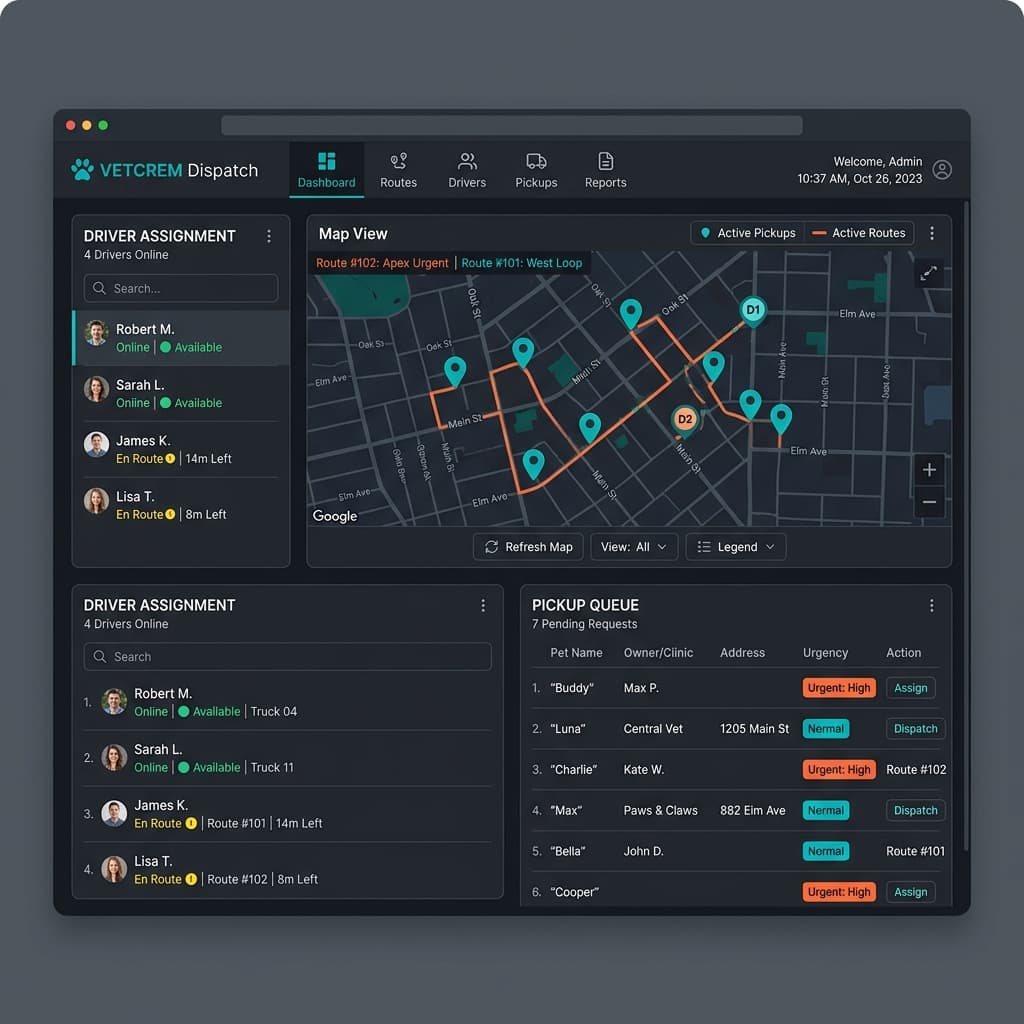
Relying on a handwritten sharpie tag to identify a grieving family's beloved pet is a catastrophic operational liability. When a paper tag smears or falls off in cold storage, your facility is faced with a massive, unresolvable crisis of identification. DispatchNode enforces an unbreakable digital chain of custody utilizing serialized QR code and barcode scanning, completely eliminating human error and guaranteeing absolute tracking integrity from the moment of pickup to the final return of the urn.
Scanning Protocols at the Retort
The most critical moment in the entire cremation process is loading the retort; an error here is irreversible and devastating. DispatchNode utilizes the barcode tracking system to enforce a strict validation protocol at the retort door, completely preventing an operator from accidentally performing a communal cremation on a pet scheduled for a private service.
Even the most experienced retort operator can make a mistake during a long, exhausting shift. If they grab the wrong transport bag from cold storage and place it into the chamber for a communal burn, they have just destroyed a family's trust and invited a massive lawsuit.
The software platform prevents this catastrophic failure. Before the operator is allowed to initiate the burn cycle, they must use a tablet to scan the barcode attached to the remains. The system instantly cross-references the scanned barcode against the central dispatch database.
If the system detects that the scanned pet is scheduled for a private cremation, but the operator has selected a communal burn cycle on the software interface, the tablet emits a massive visual and auditory alarm. It physically locks the workflow, requiring dual authorization from the facility manager to proceed. This algorithmic hard-stop guarantees that the irreversible cremation process is executed flawlessly every single time.
Transparency and the Certificate of Cremation
Families paying premium rates for private cremation demand clear proof that the process was executed with integrity. DispatchNode utilizes the timestamped data generated by the barcode scanning protocol to automatically generate a highly detailed Certificate of Private Cremation, providing the family with a digital ledger that proves their pet was tracked flawlessly.
A generic certificate is meaningless if it lacks data. The software-generated certificate utilizes the data captured by the barcode scans. It details exactly when the pet was picked up, when it was logged into the facility, the exact start and end times of the cremation cycle, and the digital signature of the specific retort operator who performed the service.
This extreme level of digital detail provides profound emotional comfort to the grieving family. It removes the nagging suspicion that plagues the industry. When the family views the digital ledger in their secure portal, they realize that the facility utilizes enterprise-grade tracking technology to ensure the safety of their pet.
This transparency is also the ultimate sales tool for securing veterinary contracts. When pitching a massive corporate veterinary hospital, the crematory owner simply demonstrates the barcode scanning protocol. The hospital director instantly recognizes that this technology completely insulates their clinic from the massive liability of a misidentified pet, securing the exclusive contract for the crematory.
Fleet Inventory Management
Barcode scanning is not just for facility tracking; it is critical for managing the payload capacity and inventory of the active transport fleet. DispatchNode utilizes the mobile scanning app to maintain a live inventory of every transport vehicle, ensuring dispatchers know exactly which pets are in which van at any given moment.
When a driver completes a sweep at a veterinary clinic, the dispatcher must know exactly how much physical capacity remains in the vehicle before routing them to an emergency residential pickup. The continuous barcode scanning provides this data instantly.
As the driver scans each pet into their vehicle, the software calculates the cumulative weight and updates the dispatcher's live dashboard. If the dispatcher needs to locate a specific pet for an expedited service, they can instantly query the database and see: "Max is currently in Transport Van 3, ETA to facility is fourteen minutes."
This level of absolute operational awareness transforms the crematory from a chaotic waste hauler into a highly sophisticated logistics enterprise. By mandating barcode tracking at every step of the process, the business guarantees perfect execution, protects its liability, and delivers an unparalleled level of professional service to grieving families and veterinary partners.
QR Code vs. RFID: Choosing the Right Tracking Medium
The choice between QR code-based tracking and RFID-based tracking depends on facility volume, budget, and the specific environmental conditions of the crematory. Each technology has distinct advantages.
| Factor | QR Code (Optical Scan) | RFID (Radio Frequency) |
|---|---|---|
| Cost Per Tag | $0.10 - $0.25 | $0.80 - $1.50 |
| Scanning Distance | Requires line of sight (< 12 inches) | Proximity (up to 3 feet) |
| Heat Resistance | Low (degrades in retort proximity) | Moderate (specialized tags available) |
| Water Resistance | Low (ink can smear) | High (sealed enclosures) |
| Data Capacity | URL link to digital record | Embedded data payload |
| Equipment Needed | Any smartphone camera | Dedicated RFID reader |
For the majority of independent pet crematories, QR codes deliver the optimal balance of low cost and high reliability. The QR code does not need to store data itself; it simply encodes a URL that links to the pet's full digital record in the cloud database. This means even if the QR tag degrades slightly, the underlying data remains permanently accessible.
Scan Failure Handling Protocol
Even the most robust tracking system must account for scenarios where a barcode or QR scan fails. The software must enforce strict escalation protocols to prevent any gap in the chain of custody.
The critical safeguard is that a failed scan does not allow the technician to simply skip the step. The system demands either a successful re-scan or a manager-approved manual override. Every manual override is flagged for weekly audit review, creating accountability that prevents staff from routinely bypassing the scanning protocol out of laziness.
The Family-Facing Transparency Portal
The ultimate expression of QR tracking technology is extending it to the family themselves. The AVMA emphasizes that transparency in aftercare builds lasting trust between the facility and the pet-owning community.
- SMS Tracking Link: After the pickup, the family receives a text message with a link to a branded portal showing the real-time status of their pet's remains.
- Status Milestones: The portal displays clear milestones: "Received at Facility" → "In Cremation Queue" → "Cremation Complete" → "Urn Ready for Pickup."
- Certificate of Cremation: Once the cremation is complete, the portal displays a downloadable PDF certificate with the operator's digital signature and timestamps.
- Photo Verification: The facility can optionally upload a photo of the urn before the family picks it up, providing visual confirmation that the memorial product matches their selection.
- Feedback Collection: After the urn is returned, the portal prompts the family for a review, capturing 5-star testimonials during the peak of gratitude.
This level of digital transparency transforms the crematory from a commodity vendor into a trusted partner. For a related analysis, review our guide on Chain-of-Custody Tracking for Pet Cremation.
The Cryptography of Trust in the Aftercare Sector
In an industry where the core product—the returned ashes of a beloved pet—is visually indistinguishable from any other set of ashes, the entire value proposition of the business relies on trust. Historically, operators have asked families to trust their reputation. However, in the modern digital economy, consumers demand verifiable proof. The integration of QR code scanning into the dispatch workflow shifts the operator's value proposition from "Trust Us" to "Verify Us," utilizing verifiable digital records to build an unassailable brand.
This digital verification begins at the exact moment of intake. When the driver scans the unique, serialized QR code attached to the pet, the software hashes that specific event, linking the pet's identity permanently to that exact geographic coordinate and timestamp. As the pet moves through the crematory—from the refrigeration bay, into the specific retort chamber, through the cremulator (the processing machine), and finally into the specific memorial urn—every single transition requires a verified employee scan.
This creates a reliable, unbroken digital ledger. If a grieving family experiences a moment of panic, wondering if the ashes they received truly belong to their Golden Retriever, the operator does not simply offer verbal reassurances. The operator opens the client's secure digital portal and provides the complete Cryptographic Tracking Dossier. The family can visually track the exact timeline of their pet's journey, seeing the specific employee ID numbers and timestamps for every stage of the process. This absolute, algorithmic transparency completely neutralizes consumer anxiety and establishes a level of trust that analog competitors cannot possibly replicate.
Automated Inventory Control and Shrinkage Prevention
Beyond providing emotional security to the client, the rigorous application of QR code tracking provides the crematory operator with massive financial security by automating inventory control and preventing shrinkage. A high-volume crematory maintains tens of thousands of dollars of inventory: premium wooden urns, specialized clay paw print kits, and expensive brass memorial plaques.
When relying on manual tracking, it is incredibly easy for a technician to grab a two-hundred-dollar walnut urn off the shelf for a private cremation and forget to deduct it from the master inventory spreadsheet. Over a fiscal year, this unrecorded shrinkage drastically erodes the facility's profit margins.
The QR code tracking system integrates directly with the facility's e-commerce and inventory modules. When a family purchases the premium walnut urn through the digital portal, the software automatically assigns a specific serial number to that urn in the warehouse. When the crematory technician is preparing the final ashes, the software specifically prompts them to scan the QR code on that exact walnut urn.
If the technician grabs the wrong urn—perhaps a less expensive cedar model—the scanner will reject the barcode, flash a red warning on the tablet, and physically prevent the technician from completing the workflow until the correct inventory item is secured. Simultaneously, the correct scan instantly deducts the item from the central inventory database, automatically triggering a reorder alert to the supplier if the stock level falls below the established minimum threshold. This automated, scan-enforced inventory control entirely eliminates human error, stops shrinkage, and ensures the operator captures the full retail margin of every memorialization product.
This automated yield management ensures the operator maximizes inventory turnover velocity without requiring human oversight, liberating the operations manager to focus entirely on cultivating high-value B2B relationships. The resulting increase in retail margin directly funds the continuous technological enhancement of the dispatch platform, creating a virtuous cycle of localized competitive dominance.
The automated inventory control also empowers the operator to implement dynamic, algorithmically generated promotional pricing for specific memorial items. If the software detects that a specific model of ceramic urn has remained stagnant in the warehouse for ninety days, tying up valuable operating capital, it can automatically trigger a ten percent discount exclusively within the digital Memorialization Gallery.
The automated inventory control also empowers the operator to implement dynamic, algorithmically generated promotional pricing for specific memorial items. If the software detects that a specific model of ceramic urn has remained stagnant in the warehouse for ninety days, tying up valuable operating capital, it can automatically trigger a ten percent discount exclusively within the digital Memorialization Gallery. This automated yield management ensures the operator maximizes inventory turnover velocity without requiring human oversight.