Transporting animal remains requires different permits depending on your state and county. At minimum, you need a business license, commercial vehicle insurance, and compliance with local health department disposal regulations. Fourteen states also require a transport manifest.
The Regulatory Landscape
There is no single federal regulation governing pet remains transport. Compliance is managed at the state and county level, creating a patchwork of requirements that operators must navigate individually for each jurisdiction they serve.
Most pet pickup operators start their business without fully understanding the regulatory environment. The requirements are not onerous, but failing to meet them can result in fines, business license revocation, and liability exposure that no amount of insurance will cover.
This guide provides the baseline compliance checklist that applies to most U.S. jurisdictions, with notes on specific state variations.
Universal Requirements (All States)
Regardless of where you operate, the following apply everywhere:
Insurance note: Standard commercial auto insurance does not automatically cover animal remains transport. You must explicitly disclose this activity to your insurer. If they learn about it from a claim rather than from your application, they can deny coverage retroactively.
State-Specific Requirements
Requirements vary by state. Here are the most common additional requirements:
| Requirement | States That Require It |
|---|---|
| Transport Manifest | CA, TX, FL, NY, IL, PA, OH, GA, NC, MI, NJ, VA, WA, MA |
| Health Dept. Notification | CA, NY, FL, IL |
| Vehicle Inspection | TX, CA, NY |
| Operator Certification | CA (voluntary but recommended) |
| Cold Storage Permit | FL, TX (if holding remains > 24 hours) |
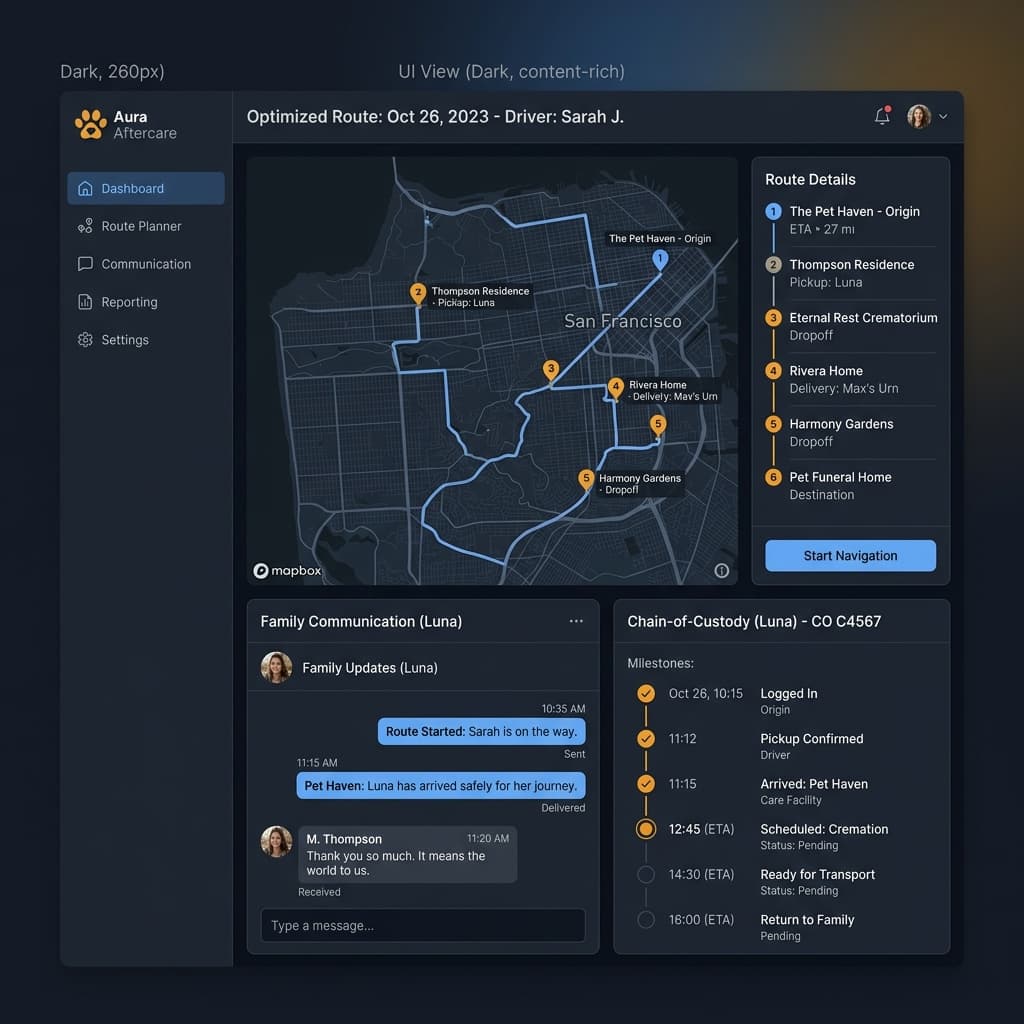
Transport manifests document the chain of custody from pickup to final disposition. The manifest typically includes: pet species and weight, owner name and address, pickup date and time, transporter name and license number, destination facility, and the disposal method chosen.
Professional pickup services generate manifests automatically through their dispatch software. This eliminates the risk of missing documentation and creates an auditable record for health department inspections.
Disposal Method Regulations
How remains are disposed of is regulated separately from transport:
| Disposal Method | Key Regulation |
|---|---|
| Private Cremation | Crematory must hold an air quality permit from the county or state EPA equivalent. |
| Communal Cremation | Same as private. Ashes from communal cremation must be disposed of at a licensed facility, not scattered publicly. |
| Home Burial | Legal in most rural areas. Prohibited in many cities. Check municipal code. Minimum depth is typically 3 feet. |
| Rendering | Commercial rendering plants require separate licensing. Not relevant to pet aftercare services. |
Your liability as a transporter ends when you deliver remains to a licensed facility and obtain a signed receipt. That receipt is your proof of proper disposition. Keep it on file for 3 years minimum.
The Complete Compliance Checklist
Use this checklist when setting up or auditing your operation:
Compliance is not optional, and it is not difficult once systems are in place. The operators who get in trouble are the ones who assumed pet transport was unregulated because "it is just a pet." The legal system does not share that assumption.
Record-Keeping and Audit Preparation
Maintain a centralized compliance file (digital or physical) that contains copies of every permit, insurance certificate, facility agreement, and vehicle inspection report. When a health department inspector visits, they expect to see this file organized and current, not scattered across filing cabinets and email threads.
Digital record-keeping is strongly recommended. Scan all physical documents and store them in a cloud folder organized by category: Licensing, Insurance, Facility Agreements, Manifests, Vehicle Records. Set automated calendar reminders 60 days before every renewal date so nothing lapses.
For manifest records, keep completed manifests on file for a minimum of 3 years. Some states require 5 years. When in doubt, keep them for 5. Storage costs nothing compared to the penalty for missing documentation during an audit.
The operators who treat compliance as a one-time setup task eventually fall out of compliance. Renewal dates pass, insurance policies change coverage terms, and state regulations update without notice. Build a quarterly compliance review into your operations calendar. One hour every 3 months prevents the kind of surprise that shuts down a business.
Keep reading: